Benjamin Franklin
Printer, diplomat, and scientist who helped engineer American independence
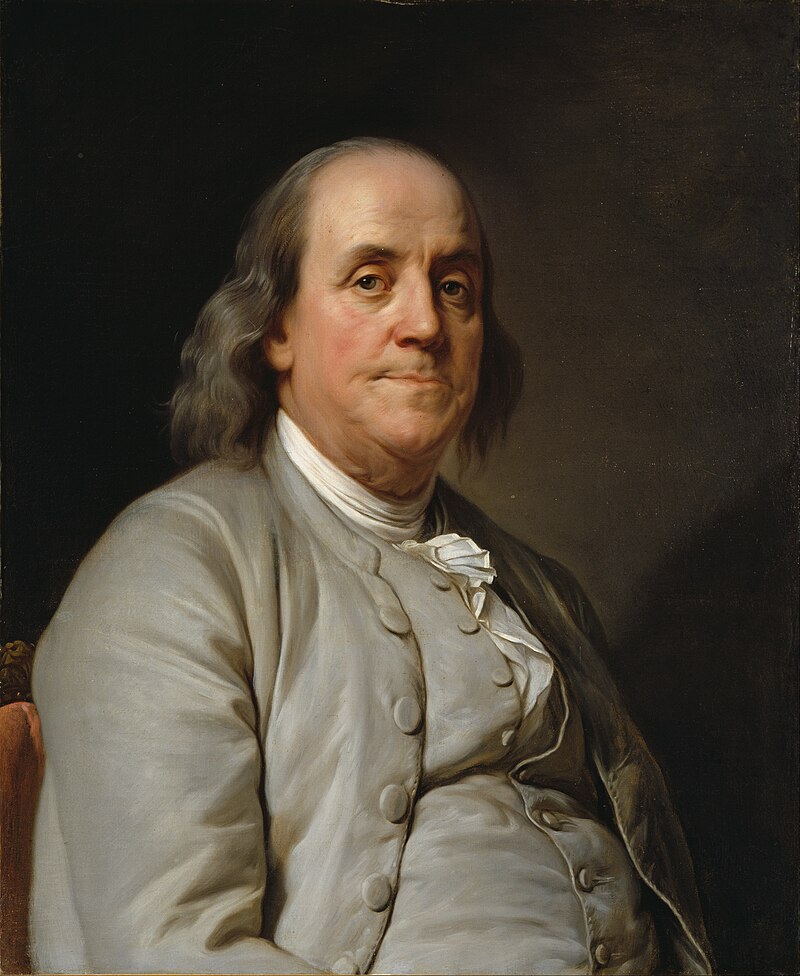
Benjamin Franklin arrived in Philadelphia at age 17 with a puffy roll under each arm, eating a third, and about a shilling to his name. By the time he died in 1790, he had helped negotiate two of the most consequential treaties in American history, demonstrated the electrical nature of lightning, established the first American lending library, and invented bifocals — all feats of a single lifetime so varied that his contemporaries already treated him as a phenomenon.
Franklin's diplomatic mission to France between 1778 and 1785 was essential to American survival in the Revolution. He cultivated French public opinion, secured loans and military support from Louis XVI's government, and co-negotiated the Treaty of Paris — all while performing the role of philosopher-statesman with the ease of a man who had been rehearsing for it his whole life. Back home, he was the oldest delegate to the Constitutional Convention at 81, still pushing for compromise when the arguments threatened to unravel the whole project. He is one of only six men to sign both the Declaration of Independence and the Constitution.
Franklin owned enslaved people for decades and printed advertisements for slave sales in his newspaper — and spent his final years as president of the Pennsylvania Abolition Society, actively petitioning Congress to end the slave trade. That late-life conversion, like so much about Franklin, resists easy categorization. He was a self-made myth who kept revising himself until the end, and the myth kept growing after he stopped.
From runaway apprentice to rich printer
Franklin was born in Boston, the 15th of 17 children of Josiah Franklin, a candle and soap maker. At 12 he was apprenticed to his older brother James, a printer. At 16 he slipped a series of letters under the door of James's newspaper, the New-England Courant, signed by an invented widow named Silence Dogood; James printed them without knowing who wrote them. The brothers quarreled, and in 1723 Benjamin broke his apprenticeship and ran away, first to New York and then to Philadelphia.
Within a decade he owned the Pennsylvania Gazette and was publishing Poor Richard's Almanack, whose sayings about thrift and hard work sold year after year. He built a network of partner print shops in other colonies and grew rich enough to retire from daily business at 42, leaving the shop to his partner David Hall. He wanted the rest of his time for science and public life.
Did Franklin really fly a kite in a thunderstorm?
Franklin proposed in 1750 that lightning was electricity and suggested an experiment to prove it, using a tall iron rod to draw charge from a storm cloud. Experimenters in France performed it successfully in May 1752, before word of their success could have reached him.
According to his own brief account, and a fuller one by the scientist Joseph Priestley published in 1767, Franklin tried his own version in Philadelphia that June: a silk kite, a wet hemp string, and a metal key near his hand, with his son William helping. He drew sparks from the key, showing that the string carried an electric charge from the cloud. He did not fly the kite into a bolt of lightning, which would probably have killed him. Because no one else recorded the event at the time, a few historians have questioned whether it happened as he described. His lightning rod soon went up on buildings across the colonies and in Europe.
What Franklin founded in Philadelphia
Franklin had a talent for turning a conversation into an institution. In 1727 he formed the Junto, a club of young tradesmen who met to debate and improve themselves. It led to the Library Company of Philadelphia in 1731, whose members pooled money to buy books they could borrow. Then came a volunteer fire company, the academy that grew into the University of Pennsylvania, Pennsylvania Hospital, which he co-founded with Dr. Thomas Bond, and the American Philosophical Society.
He also ran the colonial mails as a deputy postmaster general from 1753, improving routes and speeding delivery. He declined to patent his stove or his other inventions, writing that people should share freely in the benefits of others' ideas.
How a loyal Briton became a revolutionary
Franklin spent most of the years from 1757 to 1775 in London, representing Pennsylvania and later other colonies. For much of that time he hoped to keep the empire together. In 1766 he testified before the House of Commons against the Stamp Act, which was repealed weeks later.
The break came in January 1774. Franklin had passed private letters by Massachusetts governor Thomas Hutchinson to friends in Boston, who published them. Summoned before the king's Privy Council, he stood silent for about an hour while Solicitor General Alexander Wedderburn denounced him as a thief. The government fired him as deputy postmaster general two days later. He sailed home in 1775, joined the Second Continental Congress, and served on the committee that produced the Declaration of Independence.
His son William, royal governor of New Jersey, stayed loyal to the king. Father and son never reconciled.
His death and the 200-year bequest
Franklin died in Philadelphia on April 17, 1790, at 84, and was buried beside his wife, Deborah, in the Christ Church Burial Ground. Visitors still toss pennies onto his grave.
In his will he left £1,000 each to Boston and Philadelphia, to be lent at interest to young tradesmen and left to grow for 200 years. When the funds came due in the 1990s, they had grown to several million dollars, and the two cities spent them on trade schools and scholarships.
Timeline
- January 17, 1706Benjamin Franklin bornPrinter, diplomat, and scientist who helped engineer American independence


Related entries
Featured in these guides
- A Brief History of American LiteratureFrom an enslaved poet in colonial Boston to the Nobel Prize — the writers who gave the country its stories and its arguments.
- The Declaration of Independence: Who Wrote It and What It MeansAmerica's founding statement — who drafted it, what it actually argues, and why July 4, 1776 still matters.
- The Founding Fathers: Who They Were and What They DidThe men who declared independence, won the war, and wrote the rules — and what each one actually did.
- The Road to Revolution: How America Escalated to War, 1763-1775Twelve years of measure and countermeasure, from the Proclamation Line to the Proclamation of Rebellion.