Malcolm X
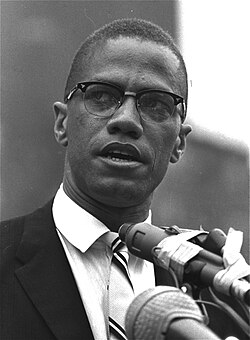
Malcolm Little was born in Omaha in 1925, the son of a Baptist preacher who organized for Marcus Garvey's Black nationalist movement and who died under a streetcar when Malcolm was six — almost certainly murdered, though the death was ruled accidental. His mother was committed to a state mental institution when he was 13. He grew up through foster care and reform schools, dropped out, moved to Boston and then Harlem, ran numbers and dealt drugs, and was convicted of burglary in 1946 and sentenced to ten years in Massachusetts state prison. In prison he discovered books, then the Nation of Islam, and underwent the most dramatic personal transformation in American public life. He emerged in 1952 as Malcolm X — the X representing the African surname stolen by slavery — and within a decade had become the most electrifying speaker in American politics.
Malcolm X's argument was direct and unsparing: that America's racial problem was not a problem of individual prejudice correctable through legislation and moral suasion, but a structural condition of white supremacy that had been in place for 400 years and that the Civil Rights movement's integrationist strategy — appealing to the conscience of white America, accepting beatings and jail without retaliating, working within a system that had never worked for Black people — was a form of self-delusion. He said this to Black audiences with a rhetorical precision and emotional directness that made the integrationist strategy look, from a certain angle, like accommodation to oppression. The FBI considered him dangerous enough to maintain extensive surveillance. Martin Luther King Jr. and he met exactly once, briefly, in 1964. Each was defining the other by contrast.
Malcolm X left the Nation of Islam in March 1964 after a break with Elijah Muhammad, made a pilgrimage to Mecca that transformed his theology — the white Muslims he met there complicated his framework of racial essentialism — and returned to the United States to found the Organization of Afro-American Unity, framing Black freedom as a human rights issue rather than a civil rights one. He was assassinated on February 21, 1965, at the Audubon Ballroom in New York, shot 15 times by Nation of Islam gunmen while his wife Betty Shabazz and their daughters watched. He was 39. His Autobiography, written with Alex Haley and published after his death, became one of the most widely read books in American history. He has been claimed by virtually every subsequent Black political tradition — nationalist, socialist, integrationist, religious — which suggests either that his thought was genuinely capacious or that it was genuinely unfinished. Probably both.

| Born | May 19, 1925 — Omaha, Nebraska |
| Died | February 21, 1965 — New York City (assassinated) |
| Birth name | Malcolm Little |
| Prison | 1946–1952 — Massachusetts (converted to Nation of Islam) |
| Left NOI | March 1964 |
| Mecca | April 1964 |
| Organization | Organization of Afro-American Unity (founded 1964) |
| Autobiography | Published 1965 (with Alex Haley) |
| Years | 1925–1965 |
| Location | New York, New York |