Chicago 1968
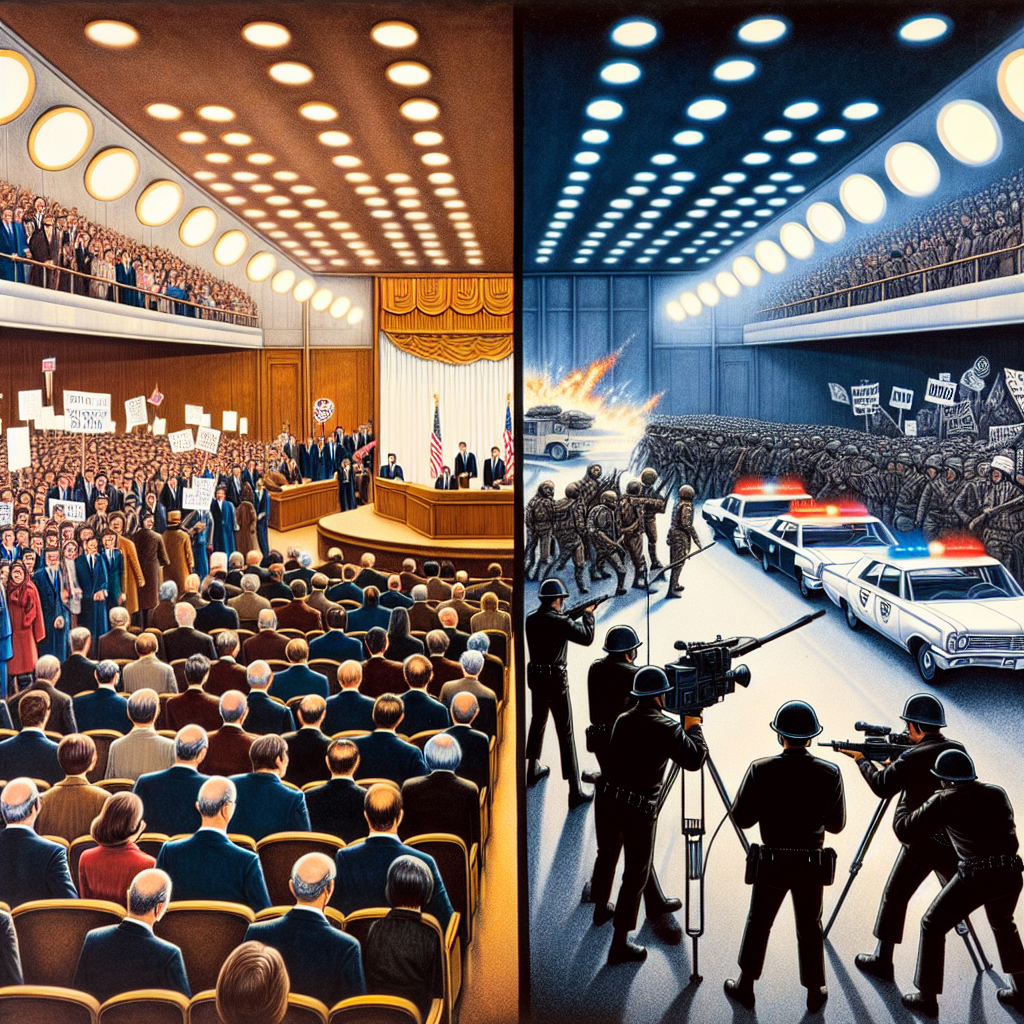
The 1968 Democratic National Convention was scheduled to be a ceremony of continuity. Lyndon Johnson's withdrawal from the race in March had made it a contest, and Robert Kennedy's assassination in June had made it a tragedy. By the time delegates arrived in Chicago in late August, the party was fractured along every line that could fracture a coalition — Vietnam, race, generational authority, and whether the people who had voted in primaries should have any influence over who the party nominated. Mayor Richard J. Daley had deployed 12,000 police, 5,000 National Guard, and 5,000 Army troops to ensure that whoever controlled the hall also controlled the streets.
Outside the International Amphitheatre, in Grant Park and on Michigan Avenue, between 10,000 and 15,000 anti-Vietnam War protesters had gathered. On the night of August 28, with the nomination fight still under way inside, police attacked demonstrators and bystanders on Michigan Avenue in what an independent federal commission later officially called a "police riot." Cameras broadcast the beatings live to the convention floor and to millions of television viewers. Delegates watching monitors saw bloodied protesters chanting "the whole world is watching." Senator Abraham Ribicoff, nominating George McGovern from the podium, said that with McGovern as president "we wouldn't have Gestapo tactics on the streets of Chicago." Mayor Daley's response from the floor has been lip-read and disputed ever since.
Hubert Humphrey won the nomination. He spent the fall campaign unable to separate himself from Johnson's Vietnam policy and unable to close the gap the convention's chaos had opened with antiwar Democrats. Nixon won by 512,000 votes — less than one percent of the popular total — with George Wallace's third-party candidacy drawing another 13 percent. A unified Democratic Party beats Nixon comfortably; Chicago prevented that unification. Eight protest organizers — the Chicago Eight — were tried for conspiracy to incite a riot in a trial that became countercultural theater. The convention's reverberations reshaped Democratic Party rules, presidential primary systems, and the American left for the next generation.
| Dates | August 26–29, 1968 |
| Location | International Amphitheatre, Chicago; Grant Park; Michigan Avenue |
| Nominee | Hubert Humphrey |
| Mayor | Richard J. Daley |
| Outside | 10,000–15,000 anti-war demonstrators |
| Official finding | Federal commission ruled police had conducted a "police riot" |
| Election result | Nixon defeated Humphrey by 512,000 votes |
| Chicago Eight | Abbie Hoffman, Jerry Rubin, Tom Hayden, et al. — conspiracy trial |
| Date | August 26–29, 1968 |
| Location | Chicago, Illinois |