Sojourner Truth
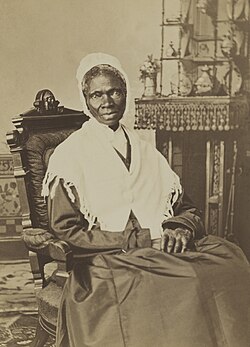
She was born Isabella Baumfree, enslaved in Dutch-speaking New York around 1797, and she escaped in 1826 — not dramatically, by night, but by walking away with her infant daughter when her enslaver failed to honor a promise to free her. She took the name Sojourner Truth in 1843, after a religious experience she described as a divine calling to travel and preach the truth. She was already in her mid-forties, largely illiterate, and possessed of a voice and presence that stopped rooms. In the years before the Civil War she became one of the most recognized figures in American reform, equally at home on abolitionist platforms and women's rights conventions, refusing to treat the two causes as separate.
The speech known as "Ain't I a Woman?" — delivered at the Women's Rights Convention in Akron, Ohio, in May 1851 — may be the most consequential piece of extemporaneous oratory in American history. Its power lay in a simple, repeated question: if women were supposedly too fragile and delicate for the vote and public life, what did that say about the Black women who had plowed fields, borne children under slavery, and watched them sold away? Truth was simultaneously dismantling the paternalist argument against women's suffrage and the racist argument that the category "woman" applied only to white women. She said what needed saying in about five minutes, and the room never recovered. The version most people know was transcribed 12 years later and embellished; the original notes suggest she was even more direct.
During the Civil War, Truth recruited Black soldiers for the Union Army and met with Lincoln at the White House in 1864. She rode Washington streetcars in deliberate defiance of segregation — years before Rosa Parks — and filed complaints against the companies that ejected her, winning policy changes. After the war she petitioned Congress for land grants to formerly enslaved people, arguing with clear-eyed practicality that freedom without economic foundation was a legal fiction. Congress did not act. She spent her final years in Battle Creek, Michigan, where she died in 1883. Her last recorded words, to a friend at her bedside, were: "I'm not going to die, honey. I'm going home like a shooting star."
| Born | c. 1797 — Swartekill, Ulster County, New York |
| Died | November 26, 1883 — Battle Creek, Michigan |
| Birth name | Isabella Baumfree |
| Escaped | 1826 — Ulster County, New York |
| Renamed | 1843 |
| Key speech | "Ain't I a Woman?" — Akron, Ohio, May 29, 1851 |
| Met Lincoln | October 29, 1864 |
| Years | 1797–1883 |
| Location | Battle Creek, Michigan |