Thomas Jefferson
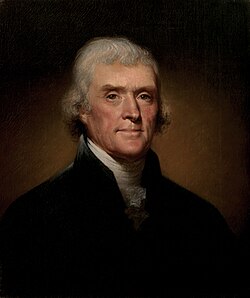
Thomas Jefferson arrived at the Constitutional Convention of 1787 as the American minister to France — meaning he missed the entire thing, watching from Paris as the document that would govern his country was drafted without him. That absence captures something essential about Jefferson: a man of enormous intellectual influence who was rarely where the action was, yet whose words shaped almost everything. He wrote the Declaration of Independence at 33, articulated the philosophical foundations of American democracy, and built Monticello over 40 years into an architectural masterpiece staffed by the 600-plus people he enslaved over his lifetime.
His presidency, 1801 to 1809, was defined by the Louisiana Purchase — a decision that doubled the country's size while requiring Jefferson to abandon his own constitutional principles — and by the Lewis and Clark Expedition he commissioned to explore it. He slashed the federal debt, eliminated the whiskey tax, and reduced the size of the army and navy, embodying a vision of limited government he called "the Revolution of 1800." He was also the first president to be inaugurated in Washington, D.C., the city he helped design.
The contradiction at the center of Jefferson's life has grown harder to rationalize with time. He wrote that all men are created equal while managing a plantation where enslaved people built his furniture, cooked his meals, and bore him children — Sally Hemings, an enslaved woman at Monticello and the half-sister of Jefferson's late wife, almost certainly had a decades-long relationship with him that produced at least six children. DNA evidence confirmed the Hemings connection in 1998. Jefferson freed only two enslaved people during his lifetime and five in his will; the remaining 130 were sold to pay his debts.
Jefferson died on July 4, 1826 — the 50th anniversary of the Declaration's adoption — within hours of John Adams, his great rival and eventual reconciled friend. Adams's reported last words were "Thomas Jefferson survives." He did not. The coincidence struck contemporaries as almost providential. Posterity has found it more ironic than divine: the man who wrote the republic's most radical promise died on its birthday, having never found a way to live up to it.


| Born | April 13, 1743 — Shadwell, Virginia |
| Died | July 4, 1826 — Monticello, Virginia |
| Term | March 4, 1801 – March 4, 1809 |
| Party | Democratic-Republican |
| Vice Presidents | Aaron Burr (1801–05); George Clinton (1805–09) |
| Preceded by | John Adams |
| Succeeded by | James Madison |
| Key role | Primary author, Declaration of Independence |
| Years | 1743–1826 |
| Location | Monticello, Virginia |