Mark Twain
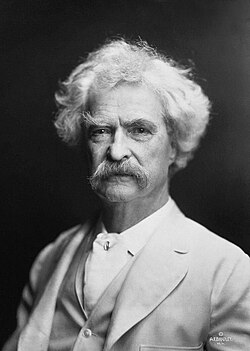
Samuel Langhorne Clemens grew up in Hannibal, Missouri, on the banks of the Mississippi River, worked as a steamboat pilot before the Civil War killed river commerce, drifted west to Nevada to mine silver and then to newspaper work, and eventually lit on the pen name Mark Twain — a Mississippi depth sounding meaning two fathoms, safe water. By the 1870s he was the most famous writer in America, a platform he used for humor, for travel writing, for nostalgia, and eventually for a moral reckoning with his country that grew darker and more unsparing as he aged.
Adventures of Huckleberry Finn, published in 1885, is the novel Ernest Hemingway claimed all American literature descends from — and it earns the claim. The story of a white boy and an escaped enslaved man floating down the Mississippi on a raft is, in its deepest current, a novel about whether a human being can outgrow the moral assumptions his society installed in him before he was old enough to question them. Huck's decision to help Jim escape, knowing he has been raised to believe this makes him wicked, remains one of American literature's most quietly revolutionary moments. The novel has been banned repeatedly — first for being too sympathetic to Black humanity, and later, with less justification, for its language.
In his final decades, Twain grew into a ferocious critic of American imperialism, the Gilded Age's worship of money, and the comfortable hypocrisies of Protestant respectability. His posthumous writings — including the unfinished Letters from the Earth — were suppressed by his estate for decades as too savage for the public. He died in 1910, broke despite having earned fortunes, still dictating an autobiography he ordered sealed for a hundred years. The version released in 2010 confirmed what readers had long suspected: that the avuncular humorist had been conducting, beneath the surface, one of the most sustained and systematic critiques of American civilization any American has ever produced.



| Born | November 30, 1835 — Florida, Missouri |
| Died | April 21, 1910 — Redding, Connecticut |
| Real Name | Samuel Langhorne Clemens |
| Pen Name | Mark Twain — Mississippi River depth sounding meaning two fathoms, safe water |
| Major Works | Adventures of Huckleberry Finn (1885); The Adventures of Tom Sawyer (1876); A Connecticut Yankee in King Arthur's Court (1889) |
| Cultural Coinage | Co-named "The Gilded Age" with Charles Dudley Warner (1873 novel) |
| Autobiography | Dictated 1906–1910; sealed 100 years; first full publication 2010 |
| Years | 1835–1910 |
| Location | Hannibal, Missouri / Hartford, Connecticut |