The Ashcan School
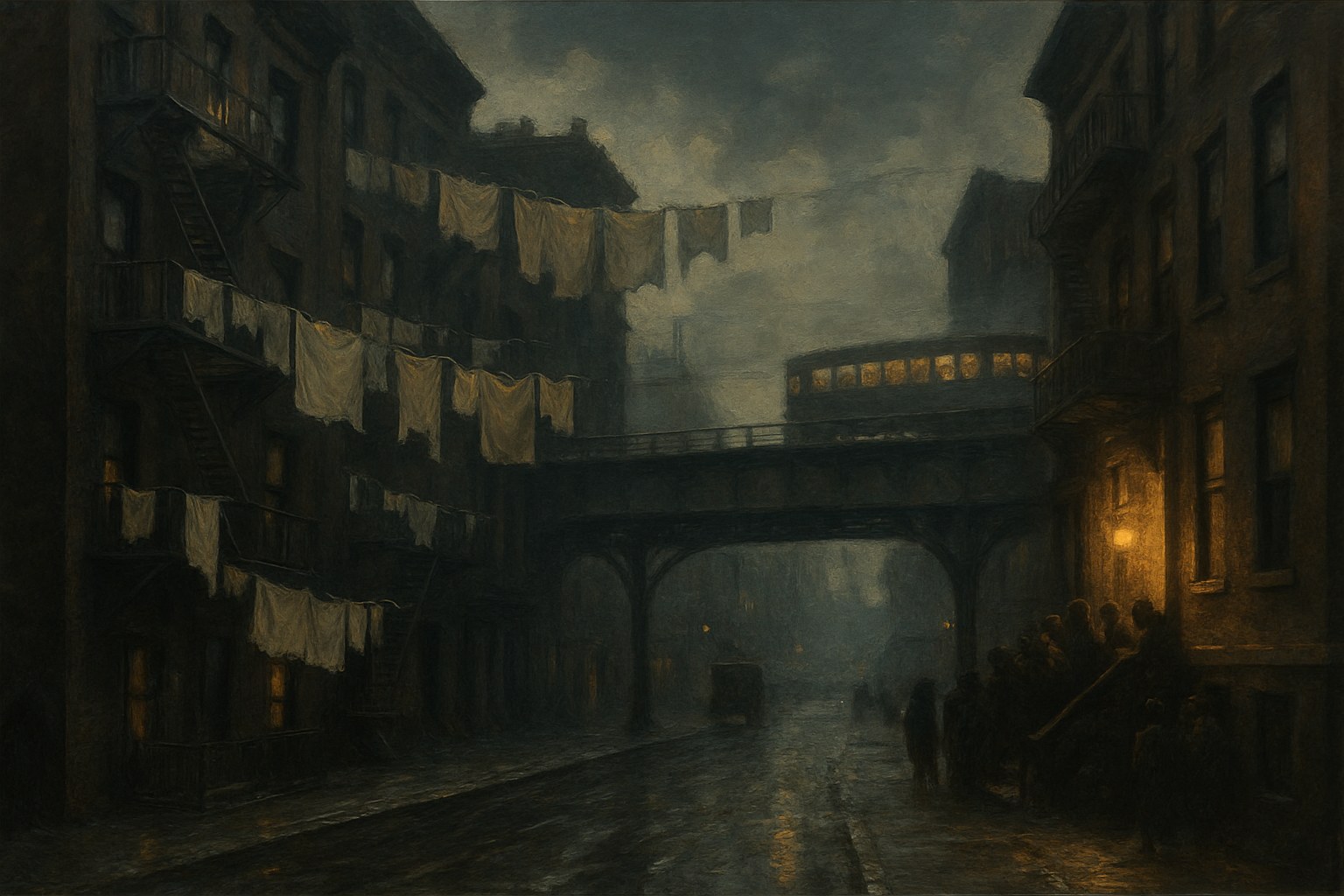
Around 1900 the National Academy of Design still decided what American painting was, and its juries preferred decorous subjects handled with a smooth finish. A Philadelphia teacher named Robert Henri thought this was a swindle. He told his students that art should be as immediate as a newspaper page and that they should paint what was in front of them, however unlovely. Several of them — John Sloan, George Luks, William Glackens, Everett Shinn — were newspaper illustrators who could sketch a street scene at speed from memory, and they carried that habit into oil paint.
The pictures that resulted were dark, loose, and hurried on purpose: laundry lines over tenement courtyards, saloon interiors, elevated trains, women drying their hair on rooftops, the crowds at Sixth Avenue. George Bellows, Henri's student, painted illegal club prizefights in slabs of black and raw pink and became the group's most powerful talent. Critics who disliked the work called it the revolt against beauty and the apostles of ugliness. The name Ashcan School came later, borrowed from a cartoon caption, and it stuck because the painters had in fact put the ash cans in the picture.
Their politics were mixed. Sloan joined the Socialist Party and drew for The Masses. Henri was closer to an anarchist temperament, insisting on the artist's independence more than on any program. Most of them were less interested in indicting poverty than in the vitality they saw in immigrant street life, which is why reformers sometimes found the paintings insufficiently outraged. In February 1908 eight painters, including Henri and four of the realists, mounted their own show at the Macbeth Galleries after Academy juries rejected their friends. The Eight drew crowds and press and proved that an exhibition could bypass the jury system entirely.
The independence they won lasted about five years. The 1913 Armory Show, organized with help from Arthur B. Davies of The Eight, brought Cezanne, Matisse, Picasso, and Duchamp to New York and reset the terms overnight. Against a cubist nude, gritty American realism looked like a quarrel about subject matter rather than about painting itself, and several Ashcan figures spent the rest of their careers as respected but no longer advanced artists. Their influence ran forward anyway, through Edward Hopper, who studied under Henri, and through every later American painter who took the ordinary city as a serious subject.
| Leader | Robert Henri, teacher and organizer |
| Core group | Sloan, Luks, Glackens, Shinn, Bellows |
| Backgrounds | Newspaper illustrators from Philadelphia |
| Breakout | The Eight at Macbeth Galleries, February 1908 |
| The name | A later coinage from a cartoon caption |
| Eclipsed | By the Armory Show of 1913 |
| Date | c. 1900-1915 |
| Location | New York City |