Edward Hopper
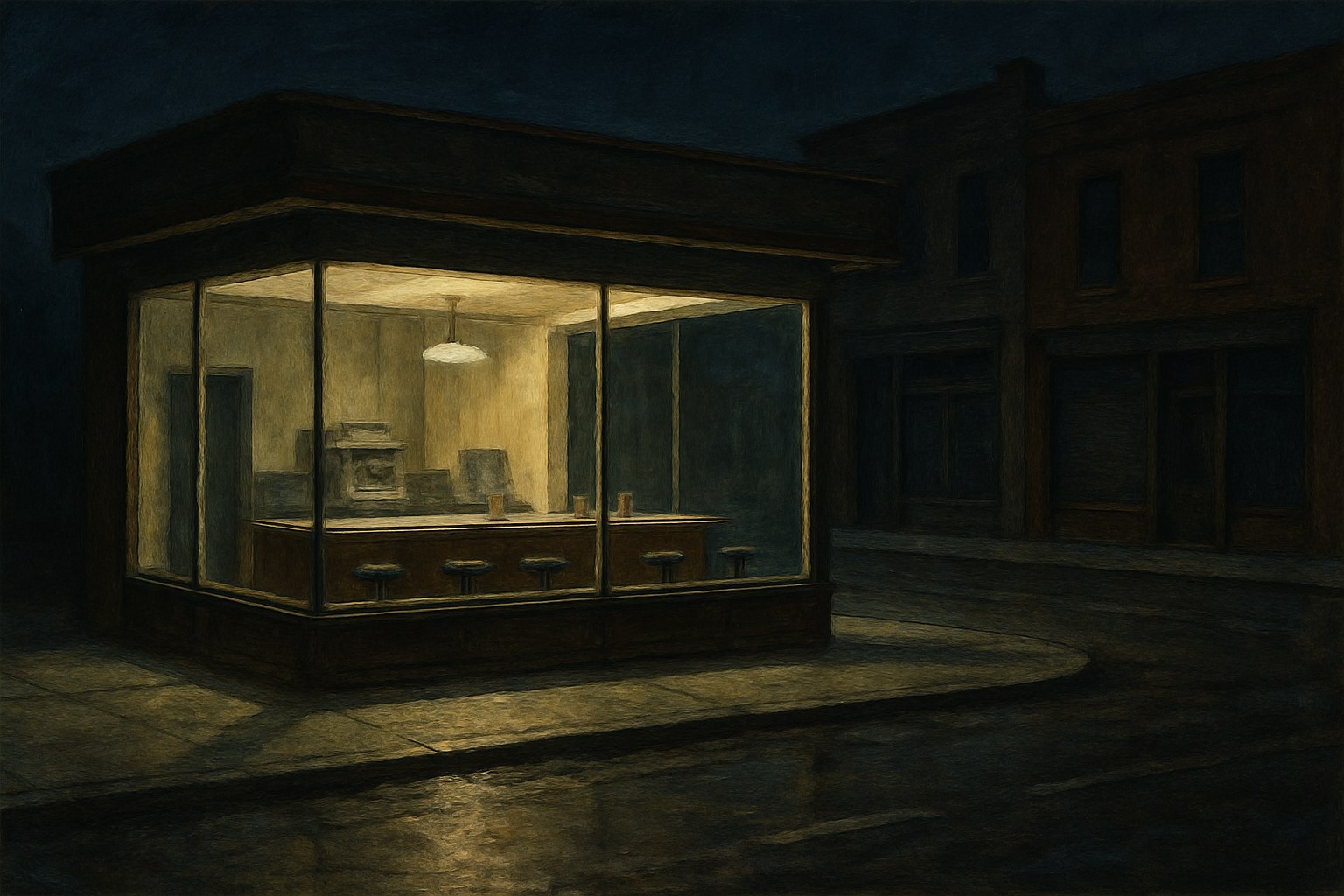
For most of his thirties and forties Edward Hopper made his living drawing advertisements for trade magazines and hated it. He had studied under Robert Henri at the New York School of Art, absorbed the Ashcan insistence on ordinary American subjects, made three trips to Paris before 1910, and sold exactly one painting at the 1913 Armory Show. Then nothing sold for ten years. He was forty-one when a show of his watercolors at a New York gallery sold out and he was able to give up commercial illustration for good.
What he painted after that was almost always the same problem: light falling on a surface, and what a person looks like inside it. A Victorian house isolated behind a railroad embankment. A woman alone at an automat with a cup of coffee. An usherette leaning against a wall in a half-empty theater. A gas station at the edge of the woods at dusk. Nighthawks, painted in the winter after Pearl Harbor and bought by the Art Institute of Chicago for three thousand dollars, put four figures in a glass-fronted diner with no visible door and became the most reproduced image in American art.
The public reads all of this as loneliness, and Hopper spent his career gently declining that reading. He said that unconsciously he had probably painted the loneliness of a large city, but he also said, repeatedly and with visible irritation at the question, that what he was after was sunlight on the side of a house. His wife Josephine Nivison Hopper, herself a painter, kept the ledger books, posed for every female figure in his mature work, and recorded their arguments in diaries that have since complicated the picture of a marriage that was not simple.
His method was slow, deliberate, and almost entirely uninfluenced by abstraction. While the New York School was covering enormous canvases in the 1950s, Hopper was still building a picture from dozens of preparatory drawings and finishing a handful of paintings a year. That refusal cost him fashion for a while and then paid off completely. Later American realists, photographers, filmmakers, and set designers went back to him constantly, and the specific quality of the light he found in diners, hotel rooms, and empty streets is now simply what mid-century America looks like in the mind.
| Born | 1882, Nyack, New York |
| Teacher | Robert Henri of the Ashcan School |
| Day job | Commercial illustrator until age forty-one |
| Best known | Nighthawks, 1942 |
| His claim | He was painting light, not alienation |
| Died | 1967, New York City |
| Date | 1882-1967 |
| Location | Nyack, New York |