The Brooklyn Bridge
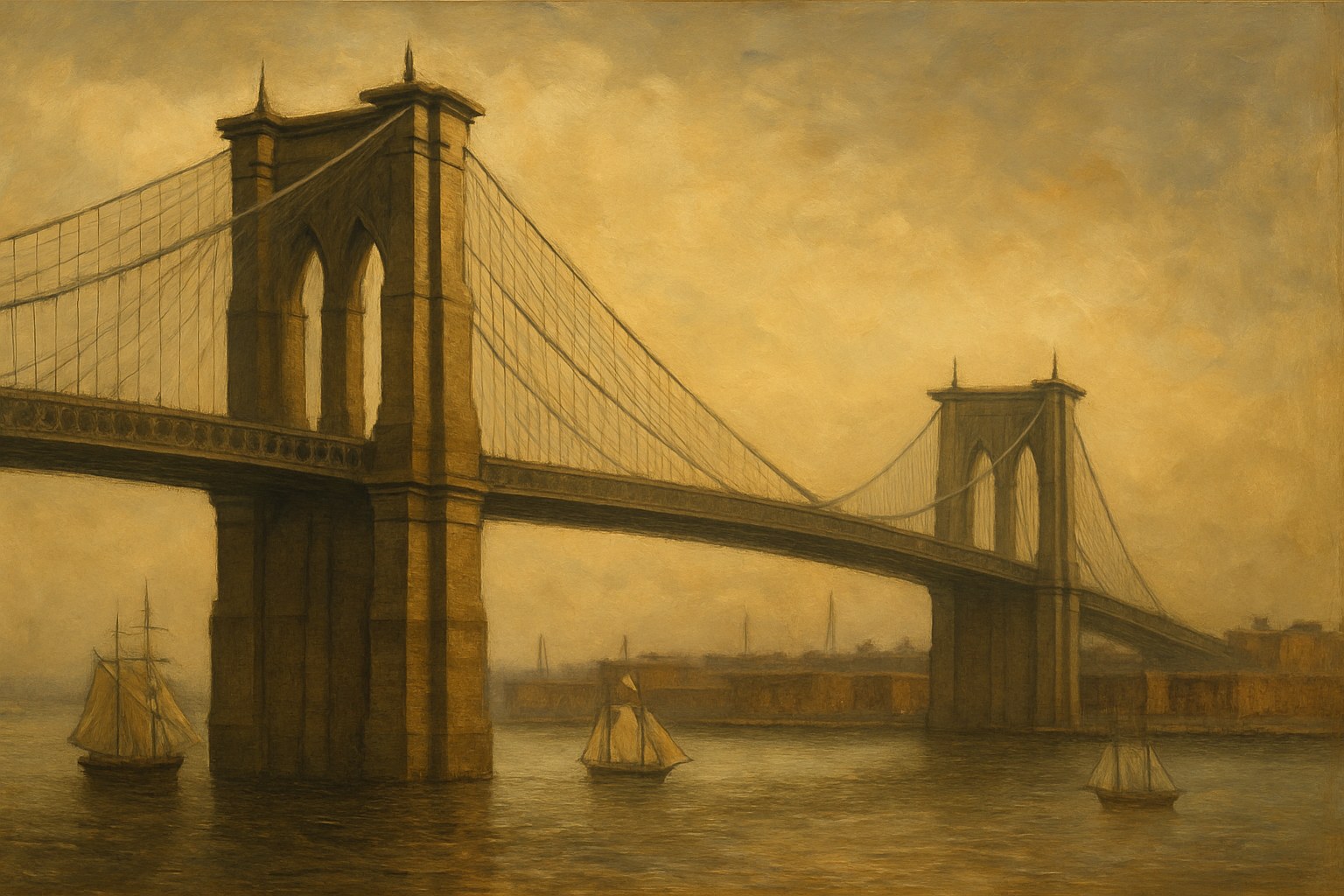
The East River froze in hard winters and the ferries stopped, cutting the independent city of Brooklyn off from Manhattan for days at a time. John Augustus Roebling, a German-born engineer who had built suspension bridges at Niagara and Cincinnati, proposed to cross it in a single span of nearly sixteen hundred feet, half again longer than anything then standing. The work was authorized in 1869. That June, surveying the Brooklyn landing, Roebling's foot was crushed between a ferry and the pilings, and he was dead of tetanus within a month.
His son Washington took over. The towers had to be founded on firm ground beneath the river, which meant sinking enormous timber caissons — inverted boxes pumped full of compressed air so that men could dig out the bottom from inside them. The work was brutal and the danger poorly understood. Laborers who surfaced too quickly suffered crippling joint pain and paralysis, an affliction the doctors on site named caisson disease and the men called the bends. Several died of it. Washington Roebling went down again and again, and by 1872 was too ill to visit the site at all.
From an apartment in Brooklyn Heights he watched the towers rise through field glasses while his wife, Emily Warren Roebling, carried his instructions down to the work. She taught herself catenary curves, cable construction, and stress analysis, dealt daily with the assistant engineers and contractors, and defended the project before the trustees when they moved to replace her husband as chief engineer. For eleven years she was in practice the bridge's working head. When it opened on May 24, 1883, she was the first person to ride across.
It was the first suspension bridge to use steel wire in its cables and the longest span in the world when it opened. Six days later a rumor that it was collapsing set off a stampede on the promenade that killed twelve people, and public nerve wavered until P. T. Barnum marched twenty-one elephants across in May 1884 to settle the question. The bridge carried trains, trolleys, carriages, and finally automobiles, bound Brooklyn to Manhattan so completely that the two merged into one city in 1898, and it still carries traffic today.



| Built | 1869-1883 |
| Designer | John A. Roebling, who died of tetanus in 1869 |
| Chief engineer | Washington Roebling, disabled by caisson disease |
| In practice | Emily Warren Roebling ran the work for eleven years |
| Main span | About 1,595 feet, the longest in the world in 1883 |
| First | First suspension bridge to use steel wire cables |
| Date | Built 1869-1883 |
| Location | New York City |