The Golden Gate Bridge
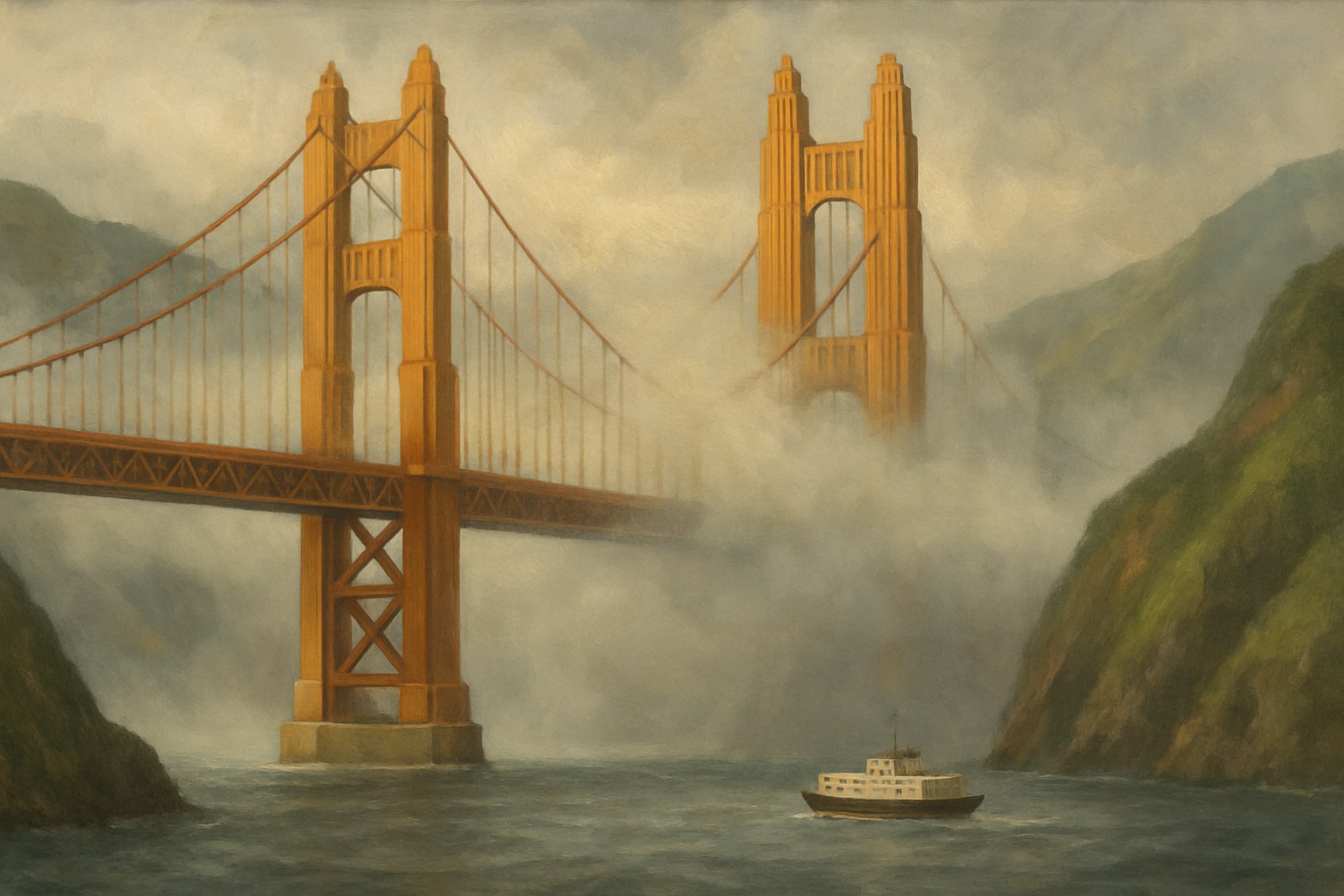
The strait at the mouth of San Francisco Bay is a mile wide, more than three hundred feet deep in the channel, swept by tides running at six knots and buried in fog for much of the year. Engineers had said for decades that it could not be bridged, or not for any price a public would pay. The ferry companies carrying tens of thousands of vehicles a year across it were not eager to be proved wrong, and the War Department, which held the forts on both headlands, had to be talked into it as well.
Joseph Strauss, a promoter at least as much as an engineer, pushed the project for years and became chief engineer, and his first design was a squat hybrid of cantilever and suspension that nobody admired. The bridge actually built came from others. Charles Alton Ellis, a professor at Illinois, did the structural mathematics across three years of calculation, and Strauss fired him in 1931 and took the credit — Ellis received no formal acknowledgment until the bridge district issued one in 2007. Irving Morrow, the consulting architect, shaped the stepped Art Deco towers and the railings.
The money was the hardest part. Six counties around the bay formed a district and in November 1930, with banks failing across the country, voted a thirty-five million dollar bond issue secured against their own homes, farms, and businesses. No one would buy the bonds until Amadeo Giannini's Bank of America took them in 1932, reportedly on the argument that California needed the bridge. Morrow also chose the color. The steel arrived coated in a reddish lead primer, and he insisted on keeping the shade, called International Orange, over the Navy's preference for black and yellow stripes.
Strauss insisted on a movable safety net strung under the deck, an unusual expense in an era whose rule of thumb held that a big bridge would cost one life per million dollars spent. Nineteen men fell into the net and lived, and named themselves the Halfway to Hell Club. Eleven died even so, ten of them in February 1937 when a work platform tore through the net. The bridge opened on May 27, 1937, held the record for the longest suspension span for twenty-seven years, and became the image by which most of the world recognizes California.

| Opened | May 27, 1937 |
| Chief engineer | Joseph B. Strauss |
| Engineering | Charles Alton Ellis, credited only in 2007 |
| Architect | Irving F. Morrow, who chose International Orange |
| Financing | A $35 million bond voted by six counties in 1930 |
| Safety net | Saved nineteen men, the "Halfway to Hell Club" |
| Date | Built 1933-1937 |
| Location | San Francisco, California |