Robert Goddard
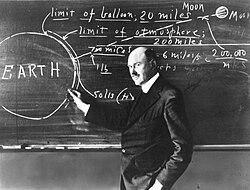
On March 16, 1926, in a snow-covered farm field in Auburn, Massachusetts, Robert Goddard ignited a liquid-fueled rocket of his own design and watched it travel 184 feet in 2.5 seconds before landing in a cabbage patch. It was the first successful flight of a liquid-propellant rocket in history — the Kitty Hawk moment of the space age, though almost no one recognized it as such at the time. Goddard had been developing rocket theory since 1909, had received U.S. patents for multistage rockets and liquid-fueled rocket concepts, and had published a 1919 Smithsonian monograph proposing that a rocket could reach the moon. The New York Times editorial board ridiculed the idea, suggesting Goddard lacked the basic physics knowledge of a high school student.
Goddard spent the following decades at a remote ranch near Roswell, New Mexico, funded by a Guggenheim Foundation grant arranged by Charles Lindbergh, conducting hundreds of rocket tests away from the public embarrassment his work tended to attract. He developed gyroscopic stabilization, regenerative cooling, and clustered engines — fundamental technologies that appear in every rocket engine built since. The German rocket program that produced the V-2 missile drew heavily on his published research, and Wernher von Braun, who led the V-2 program and later the American space effort, acknowledged Goddard as his primary inspiration.
Goddard died in 1945, the year the V-2 was first used in combat, before the space age he had made possible arrived. In 1960, the U.S. government paid his estate $1 million to settle patent infringement claims for technologies used in the American space and missile programs. The New York Times published a correction to its 1920 editorial in 1969, the day after Apollo 11 left Earth's atmosphere — 49 years late. NASA's Goddard Space Flight Center in Greenbelt, Maryland, was named in his honor.

| Born | October 5, 1882 — Worcester, Massachusetts |
| Died | August 10, 1945 — Baltimore, Maryland |
| First launch | March 16, 1926 — Auburn, Massachusetts — first liquid-fuel rocket |
| Research base | Roswell, New Mexico, 1930s–1940s — Guggenheim-funded |
| Key patents | Multistage rockets; liquid propellant; gyroscopic stabilization |
| Patent settlement | U.S. government paid estate $1 million, 1960 |
| Named honor | NASA Goddard Space Flight Center, Greenbelt, Maryland |
| Years | 1882–1945 |
| Location | Worcester, Massachusetts |