Jimmy Carter
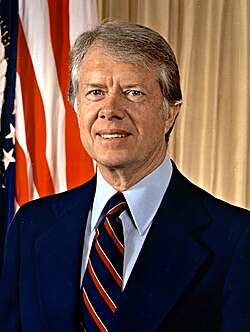
Jimmy Carter arrived in Washington in January 1977 carrying his own luggage, and walked the inaugural parade route in a plain suit rather than a morning coat. The gestures were deliberate: after Watergate and Vietnam, Carter offered plainness, honesty, and a Southern Baptist moral seriousness as correctives to imperial presidency. He was a nuclear engineer, a former naval officer, a one-term Georgia governor, and almost entirely unknown when he announced his candidacy in 1974. He won the Democratic nomination and the presidency on character, and then discovered that character alone doesn't govern.
Carter's presidency was battered by events he could not control — the 1979 oil shock, the Soviet invasion of Afghanistan, and above all the 444-day Iran hostage crisis, which began when Iranian students seized the U.S. Embassy in Tehran in November 1979. The failed April 1980 rescue operation, in which eight American servicemen died in a desert collision before reaching Tehran, cemented the administration's image as earnest in intention and cursed in execution. Ronald Reagan won the 1980 election in a landslide; the hostages were released minutes after Reagan took the oath of office.
The Camp David Accords of September 1978 were Carter's unambiguous triumph. Thirteen days of personal mediation produced a framework peace between Egypt and Israel — the first agreement between Israel and any Arab neighbor — that has held for more than four decades. It remains the most substantive achievement of his presidency and one of the most remarkable feats of personal diplomacy in the postwar era.
Carter's post-presidency set a standard no successor has matched. Through the Carter Center he monitored elections across the developing world, led disease eradication campaigns that brought Guinea worm disease to the edge of elimination, and built houses with Habitat for Humanity into his 90s. He received the Nobel Peace Prize in 2002 "for his decades of untiring effort." Carter died on December 29, 2024, at 100 years old — the longest-lived president in American history.



| Born | October 1, 1924 — Plains, Georgia |
| Died | December 29, 2024 — Plains, Georgia |
| Term | January 20, 1977 – January 20, 1981 (39th President) |
| Party | Democrat |
| Vice President | Walter Mondale |
| Key achievement | Camp David Accords, September 1978 |
| Major crisis | Iran Hostage Crisis, 444 days (1979–1981) |
| Nobel Peace Prize | 2002 |
| Longevity | Longest-lived U.S. president (100 years) |
| Years | 1924–2024 |
| Location | Plains, Georgia |