Georgia O'Keeffe
On New Year's Day 1916 a friend carried a roll of charcoal abstractions into the New York gallery known as 291 and showed them to its owner, Alfred Stieglitz, without asking the artist's permission. Stieglitz hung them that spring, also without asking. Georgia O'Keeffe, then teaching art in a small Texas college town, came to New York to object and stayed. She was twenty-eight, had trained in Chicago and at the Art Students League, and had recently burned or abandoned most of her earlier work in order to start over with shapes of her own.
The desert came later. Through the 1920s she was a painter of New York. She and Stieglitz, whom she married in 1924, lived high in the Shelton Hotel, and she painted the city hard-edged and vertical — the Radiator Building at night, the Shelton with the sun flaring off it, the East River under smoke. The male painters of Stieglitz's circle told her the skyscraper was not her subject. She painted about twenty of them anyway. In the same years she began the enormous close-up flowers that made her famous and that she spent sixty years trying to get people to see plainly.
The flowers were read, from the beginning, as sexual imagery, a reading encouraged by Stieglitz's own promotion of her as an instinctive feminine artist. O'Keeffe rejected it flatly and repeatedly, saying she had enlarged the blossoms so that hurried New Yorkers would be forced to look at something they never looked at. Critics kept the interpretation anyway, and it followed her into every survey of twentieth-century art. Whether an artist's stated intention should settle the question is a fair argument. That she stated hers clearly, for decades, is not in doubt.
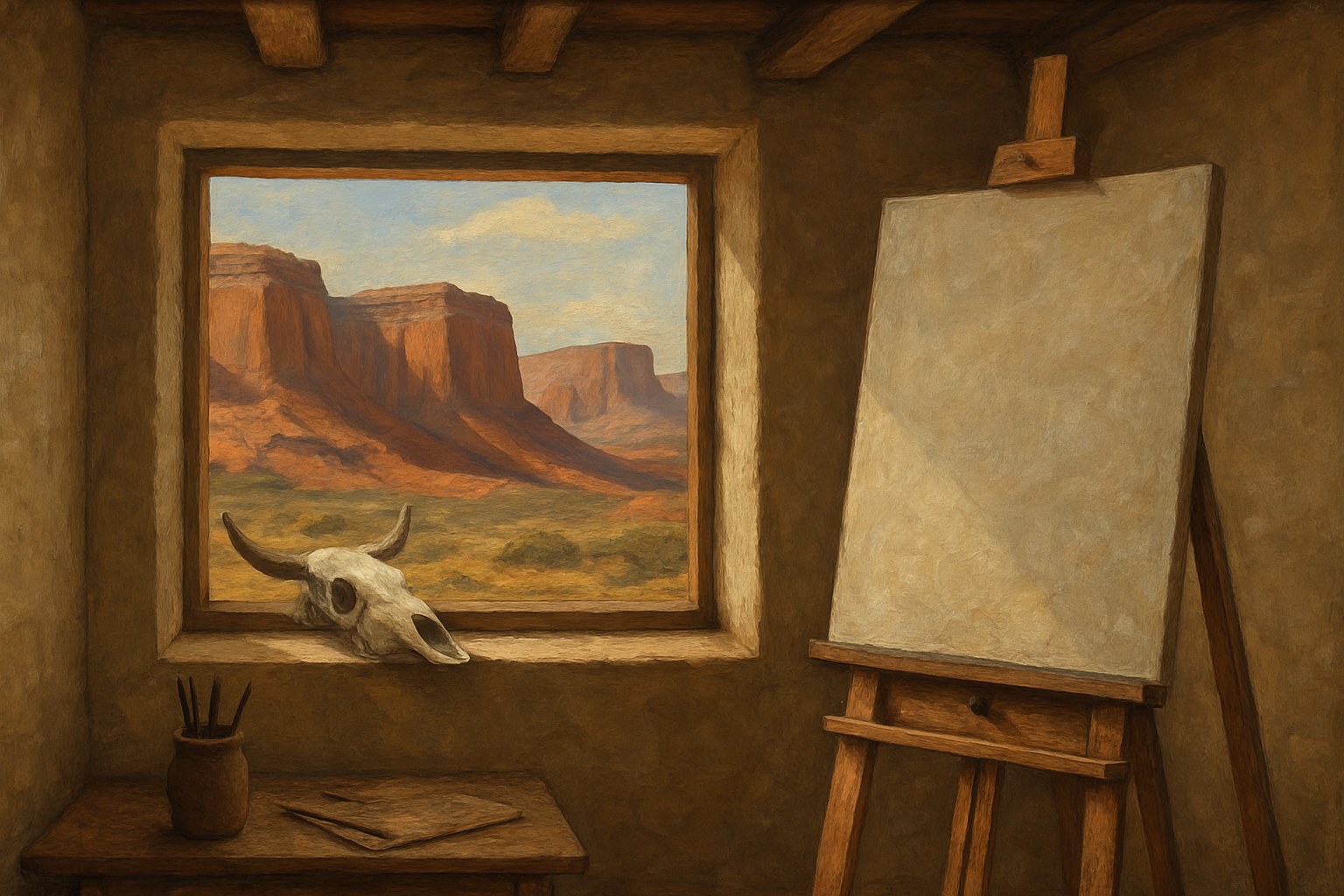
In 1929 she went to New Mexico and found the landscape she wanted. From 1934 she summered at Ghost Ranch, bought a house there in 1940, restored a ruined adobe compound in the village of Abiquiu in 1945, and moved permanently after Stieglitz died in 1946. She painted bleached pelvises with the sky showing through them, the red and yellow cliffs, a black door in an adobe wall over and over, and in her seventies the view of clouds from an airplane window. She worked into her nineties, losing her central vision, and died in Santa Fe at ninety-eight.


| Born | 1887, Sun Prairie, Wisconsin |
| Discovered | By Alfred Stieglitz at 291, 1916 |
| First subject | New York skyscrapers, 1925-1929 |
| Famous for | Magnified flowers and desert bones |
| New Mexico | Ghost Ranch from 1934, Abiquiu from 1945 |
| Died | 1986, Santa Fe, at ninety-eight |
| Date | 1887-1986 |
| Location | Abiquiu, New Mexico |