The National Parks of America
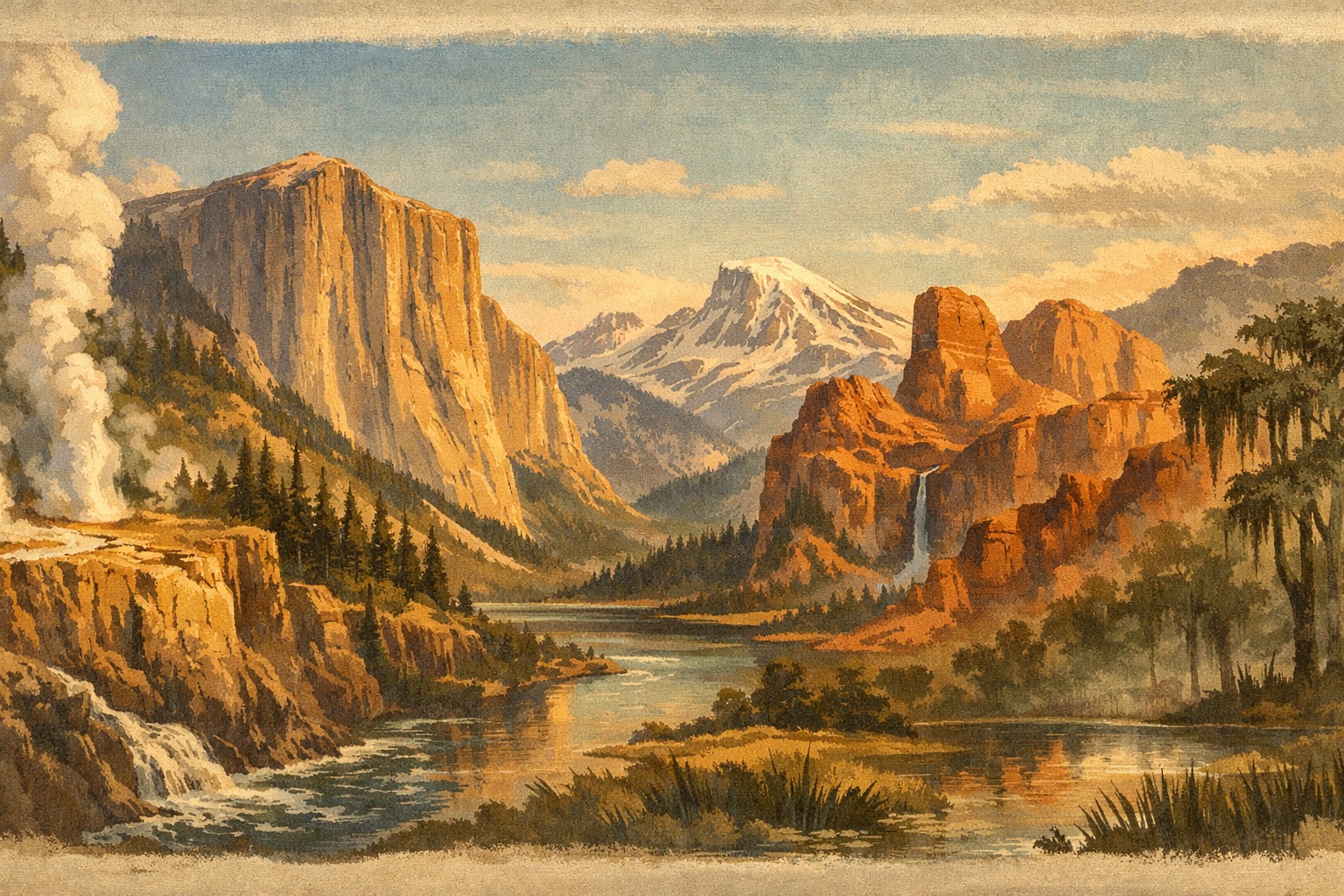
In 1872, Congress did something no national government had tried before: it set aside more than two million acres of Wyoming wilderness and declared that no one would ever own it. Yellowstone had no obvious landowner to displace, no nearby city wanting the ground for farms or timber, and few people who thought the gesture would matter -- yet the idea it created spread across the next seventy-five years with no overall design behind it. A park got added here because a local advocate would not stop lobbying Congress. A park got added there because an industrialist wanted to protect a view he loved. Fourteen parks make up the record today, and they arrived in waves that track the country's political changes more closely than its geography: an opening cluster drawn from Gilded Age ambition, a crowded surge once the National Park Service itself was created in 1916 to manage the growing patchwork, a New Deal run tied to federal confidence and relief-era budgets, and a late scattering of additions that finally extended the idea past mountains and canyons to marshland and rainforest.
This guide walks all fourteen parks in the order Congress actually created them, era by era, because the order is the history. Read straight through, it shows the national park idea itself growing up -- from one improbable reservation in Wyoming to a federal system confident enough, seven decades later, to protect a Florida swamp for no reason but the value of the ecosystem itself. It also surfaces a harder throughline. Nearly every one of these landscapes had people living on it, hunting it, or passing through it generations before a surveyor called it empty, and several of the parks below were created by removing or restricting the Native nations who used that land first.
Each entry links to its full BriefHistory profile, with a note on what makes the place worth the trip and the piece of its history worth knowing before you go.
For the political fights, naming disputes, and presidential visits behind ten of these same parks, see The Most Historic National Parks. For the larger story of the land these parks sit on, read Westward Expansion: Explorers, Events, and Turning Points.