Great Smoky Mountains National Park
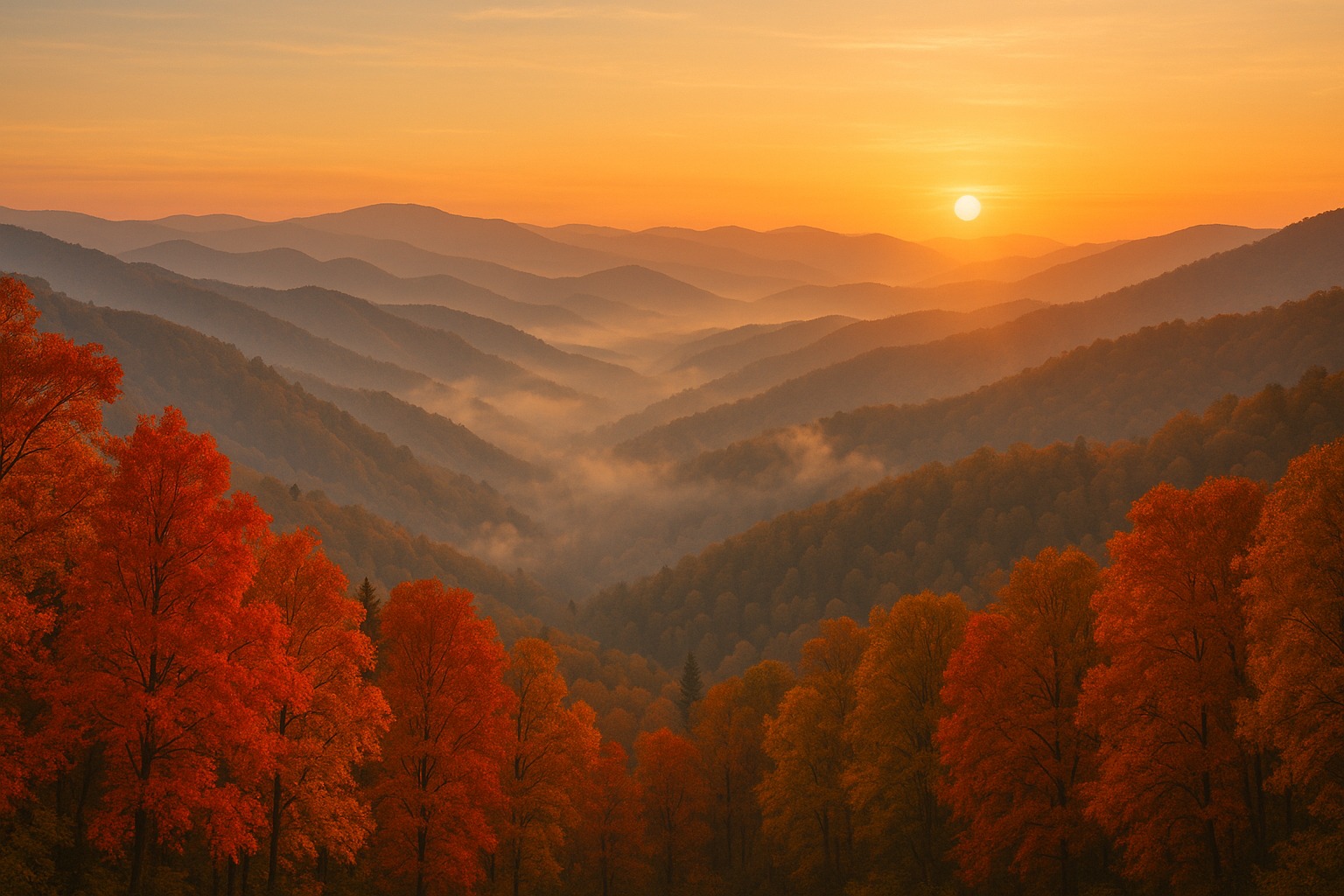
Great Smoky Mountains National Park straddles the Tennessee-North Carolina border across 522,000 acres of the southern Appalachian range, named for the bluish haze that hangs over its ridges — vapor released by the dense temperate hardwood forest that covers them. The Cherokee lived in and managed the range for centuries; those who escaped removal in 1838 hid in the high country and now form the Eastern Band, whose Qualla Boundary reservation borders the park's south entrance. The forest itself is one of the most biologically diverse temperate ecosystems on earth — more than 19,000 documented species, with credible estimates that 80,000 to 100,000 more remain undescribed.
Unlike Yellowstone or Yosemite, the Smokies were not carved out of unsettled federal land. They were assembled in the 1920s and 1930s through eminent-domain purchase, parcel by parcel, displacing roughly 6,600 families of mountain farmers and timber workers — many of whose ancestors had lived in those hollows for six generations. The federal money came from John D. Rockefeller Jr.'s $5 million matching grant and from school children across Tennessee and North Carolina who collected pennies. The Civilian Conservation Corps built the trail system, ranger stations, and most of the infrastructure visitors still use. The park was dedicated by Franklin Roosevelt at Newfound Gap in 1940.
It is the most-visited national park in the United States, with about 12 to 14 million visitor entries annually — more than the next two parks combined — and unlike most major parks it has never charged an entrance fee, a condition imposed by Tennessee when it deeded U.S. Route 441 across the park in the 1930s. The displacement remains a quiet wound. Restored cabins along Cades Cove and the abandoned Methodist church at Cataloochee mark where Appalachian communities used to be. The descendants of the displaced still hold annual homecomings in the park, where the federal government took the land their families had farmed for generations to give it back to the public.


| Authorized | 1926 |
| Established | June 15, 1934 · Dedicated September 2, 1940 |
| Area | 522,000 acres |
| Location | Tennessee–North Carolina border, southern Appalachians |
| Annual visitors | ~12–14 million (most-visited U.S. national park) |
| Families displaced | ~6,600 by eminent-domain purchase |
| Entrance fee | None (condition of Tennessee's deeding of U.S. 441) |
| UNESCO | World Heritage Site (1983) |
| Date | Authorized 1926 · Established June 15, 1934 · Dedicated September 2, 1940 |
| Location | Gatlinburg, Tennessee |