Treaty of Guadalupe Hidalgo
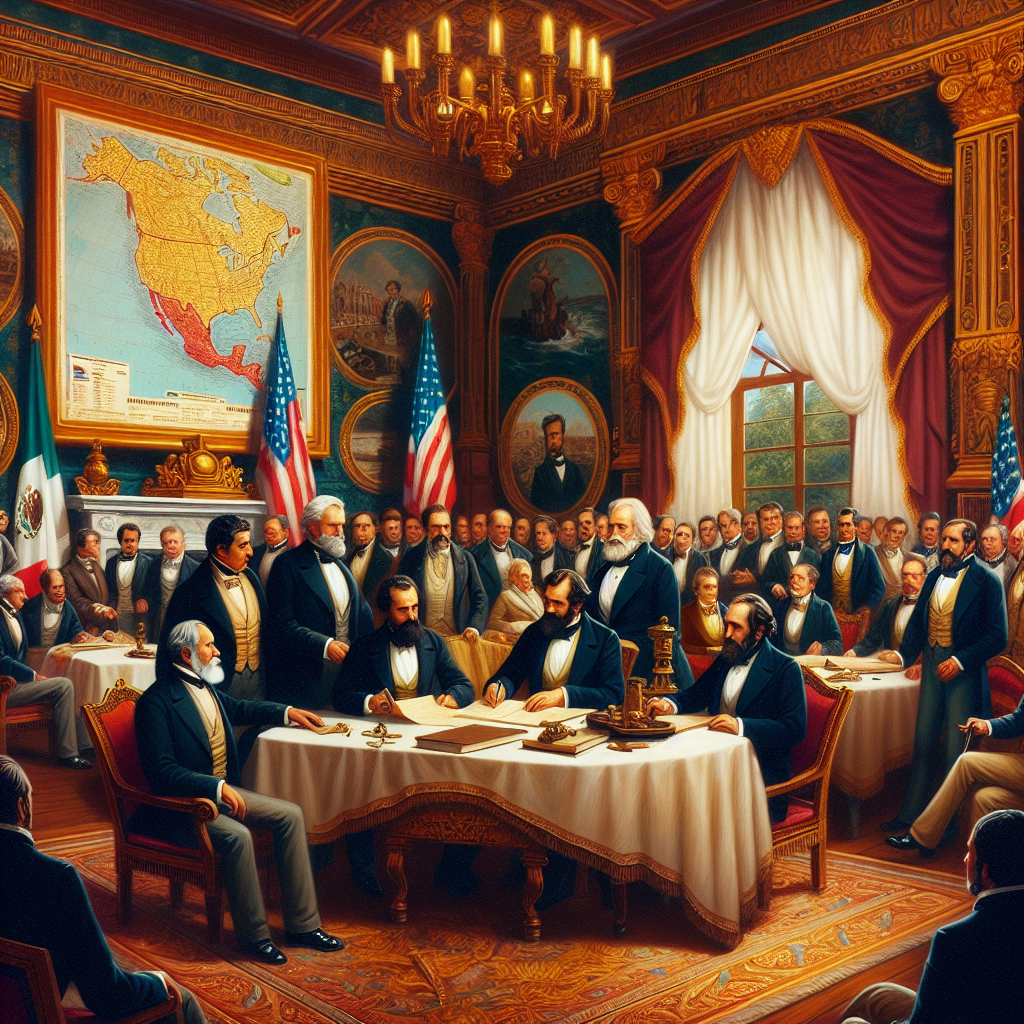
The Treaty of Guadalupe Hidalgo, signed February 2, 1848, ended the Mexican-American War and transferred to the United States roughly 525,000 square miles of territory — the future states of California, Nevada, Utah, Arizona, New Mexico, and parts of Colorado and Wyoming. Mexico received $15 million and the United States' assumption of $3.25 million in American claims against Mexico. The treaty also granted U.S. citizenship to the approximately 80,000 Mexicans living in the ceded territory who chose to remain, and guaranteed their property rights — guarantees that were systematically violated over the following decades as American settlers and courts stripped Mexican land grant holders of their property.
The treaty arrived in Washington as the country was already debating whether slavery would be permitted in the territories it would create. The Wilmot Proviso, which would have banned slavery from all territory acquired from Mexico, had passed the House twice and failed the Senate twice. The vast new territory ripped open the compromise that had held the Union together since 1820. California applied for admission as a free state almost immediately after the gold rush began in 1848, threatening to tip the Senate balance permanently. The crisis produced the Compromise of 1850, which held for another decade before collapsing into the Civil War.
The treaty is still litigated in American courts. Mexican land grant heirs have filed claims under its provisions as recently as the 21st century, arguing that the property right guarantees were never honored. The border it established — adjusted slightly by the Gadsden Purchase of 1853 — remains the international boundary today. The cultural and demographic consequences of the treaty, which placed a large Spanish-speaking Catholic population under American sovereignty and established the borderlands that remain one of the most complex regions in North America, continue to shape American society.

| Signed | February 2, 1848 |
| Territory ceded | Approximately 525,000 square miles — California, Nevada, Utah, Arizona, New Mexico, parts of Colorado and Wyoming |
| Payment | $15 million to Mexico; U.S. assumed $3.25 million in claims |
| Citizenship | Granted to ~80,000 Mexicans who remained in ceded territory |
| Political impact | Intensified slavery expansion debate; led to Compromise of 1850 |
| Border | Established current U.S.-Mexico boundary (adjusted by Gadsden Purchase, 1853) |
| Negotiated by | Nicholas Trist for the United States |
| Date | Signed February 2, 1848 |
| Location | Guadalupe Hidalgo, Mexico (now part of Mexico City) |