Hip-Hop
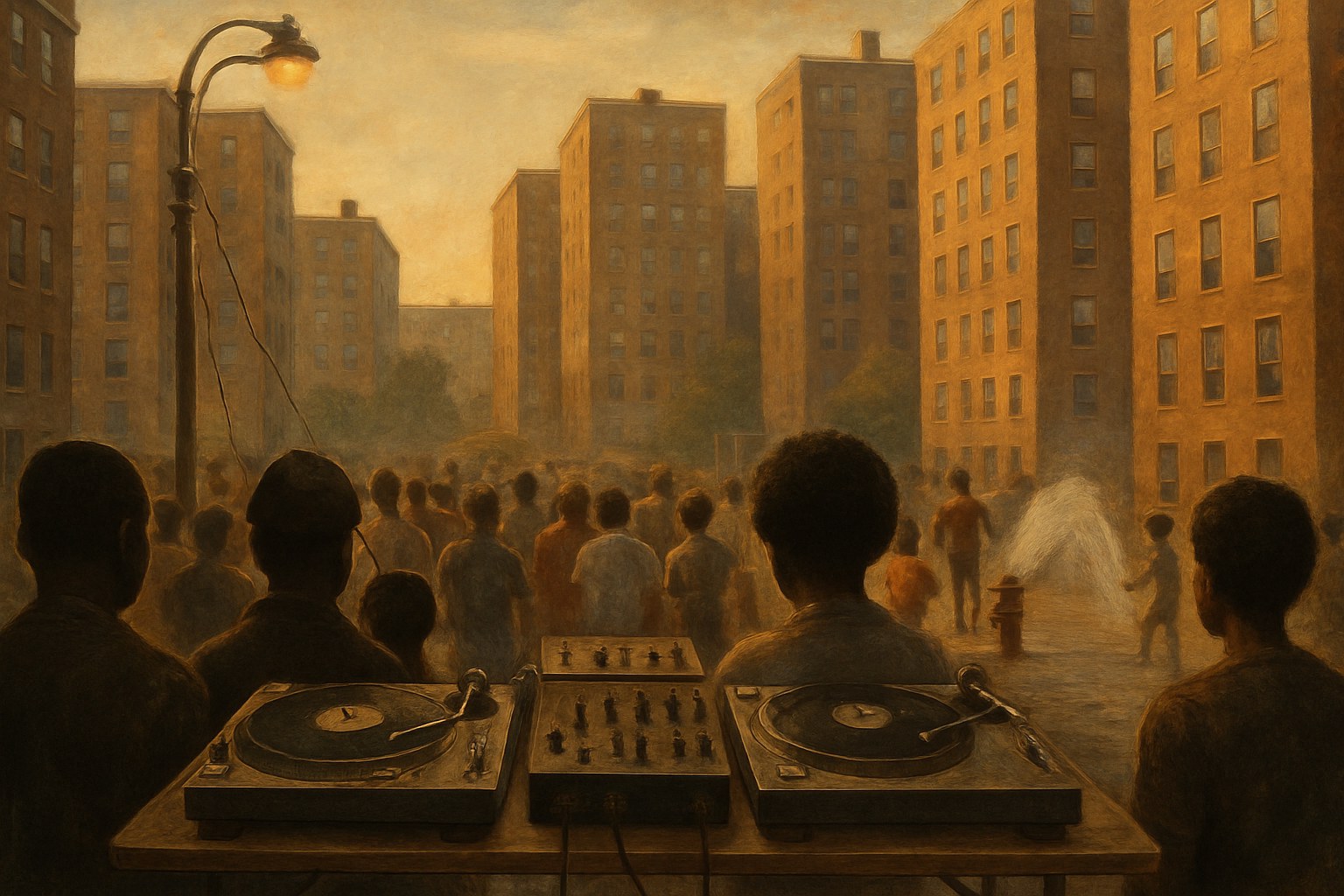
The Bronx in the early 1970s had been hollowed out by expressway construction that cut whole neighborhoods in half, by landlord arson, and by a city government sliding toward bankruptcy. Music programs had been cut from the schools, so a generation grew up without free instruments or lessons. On August 11, 1973, at a back-to-school party in the recreation room of 1520 Sedgwick Avenue, an eighteen-year-old Jamaican immigrant named Clive Campbell, working as DJ Kool Herc, did something small with two turntables and a mixer that turned out to be foundational.
He isolated the percussion break of a funk record — the few seconds where everything drops out but the drums, and the seconds dancers liked best — and used a second copy of the same record to loop it for as long as he wanted. That technique organized everything after it. Dancers who worked the break became b-boys and b-girls. A master of ceremonies talked over the loop to work the crowd, and the talk became rhyme, then verse. Afrika Bambaataa built a following and an ideology around it, and Grandmaster Flash turned turntable handling into a precise discipline.
The culture named four elements — DJing, MCing, breaking, and graffiti writing — and existed for six years as live party music before anyone thought to put it on a record. The Sugarhill Gang's Rapper's Delight in 1979 sold in the millions and startled the originators, several of whom regarded the group as outsiders assembled by a label. Commercialization moved fast after that. The digital sampler let producers build tracks from fragments of older records, an approach that was both a form of musical archaeology and a legal problem, and court rulings by the early 1990s made uncleared sampling prohibitively expensive.
Within roughly thirty years of the Sedgwick Avenue party, hip-hop was the dominant idiom of American popular music and a global one, having absorbed or reshaped the production of pop, rock, and country along the way. Its rise brought sustained argument over misogyny and violence in its lyrics, over who profits from it, and over whether mass white consumption of Black music had changed in kind since the 1950s or only in scale. It also became, for much of the world, the most legible American cultural export of its era.


| Origin | August 11, 1973, 1520 Sedgwick Avenue, the Bronx |
| Founder figure | DJ Kool Herc (Clive Campbell), a Jamaican immigrant |
| Innovation | Looping the percussion break with two turntables |
| Four elements | DJing, MCing, breaking, graffiti writing |
| First hit | The Sugarhill Gang, Rapper's Delight, 1979 |
| Sampling | Reshaped production — and provoked landmark copyright rulings |
| Date | From August 1973 |
| Location | The Bronx, New York |