Sequoyah
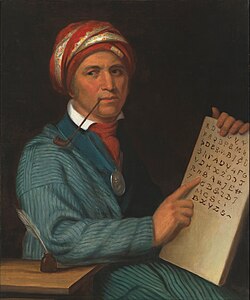
Sometime around 1821, Sequoyah presented the Cherokee Nation with something no individual in recorded history had accomplished alone: a complete writing system for a spoken language, created by a man who could not read or write in any other tongue. The Cherokee syllabary — 86 characters representing every sound in the Cherokee language — was the product of roughly 12 years of solitary work, during which neighbors concluded he had gone mad and his wife burned his notes in alarm. Within months of its adoption, thousands of Cherokee were literate. Within years, the Nation had a newspaper.
Sequoyah was born in what is now Tennessee around 1770, the son of a Cherokee woman and possibly a European fur trader. He worked as a silversmith and became fascinated by what he called "talking leaves" — written documents — observing that white settlers could communicate through marks on paper in ways Cherokee could not. His first attempt was a pictographic system with thousands of symbols. He abandoned it and spent years reducing the language to its component sounds, eventually creating a syllabary elegant enough that a Cherokee speaker could learn it in a matter of days, with no teacher required.
The syllabary transformed Cherokee political and cultural life. The Cherokee Phoenix — the first Native American newspaper — began publication in 1828 in both Cherokee and English. The Nation used the syllabary to write its own constitution, legal codes, and religious texts. The literacy rate among Cherokee became, by some accounts, higher than among white Americans in neighboring states. Sequoyah's achievement could not protect the Nation from the Indian Removal Act of 1830 or the Trail of Tears that followed — but it gave the Cherokee a cultural foundation that no forced march could destroy.
| Born | c. 1770 — Taskigi, Tennessee (exact date unknown) |
| Died | c. August 1843 — near San Fernando, Mexico |
| Achievement | Created Cherokee syllabary, c. 1821 |
| Syllabary | 86 characters representing all Cherokee sounds |
| Cherokee Phoenix | First Native American newspaper, est. 1828 |
| Recognition | Cherokee Nation silver medal and lifetime annuity |
| Singular distinction | Only known person to create a writing system without prior literacy |
| Possible namesake | Sequoia trees (etymology debated) |
| Years | 1770–1843 |
| Location | Taskigi, Tennessee |