Jackson Pollock
He was born in Cody, Wyoming, in 1912 and raised on a series of failing farms in Arizona and southern California, the youngest of five brothers in a family that kept moving. At eighteen he followed one of them to New York and enrolled with Thomas Hart Benton, the regionalist muralist, who taught him rhythm and composition through copying old masters and who became a substitute father. Nothing about the training pointed toward abstraction. Pollock spent the 1930s painting dark, thickly worked figures, drinking heavily, and drawing a federal relief paycheck from the WPA art project.
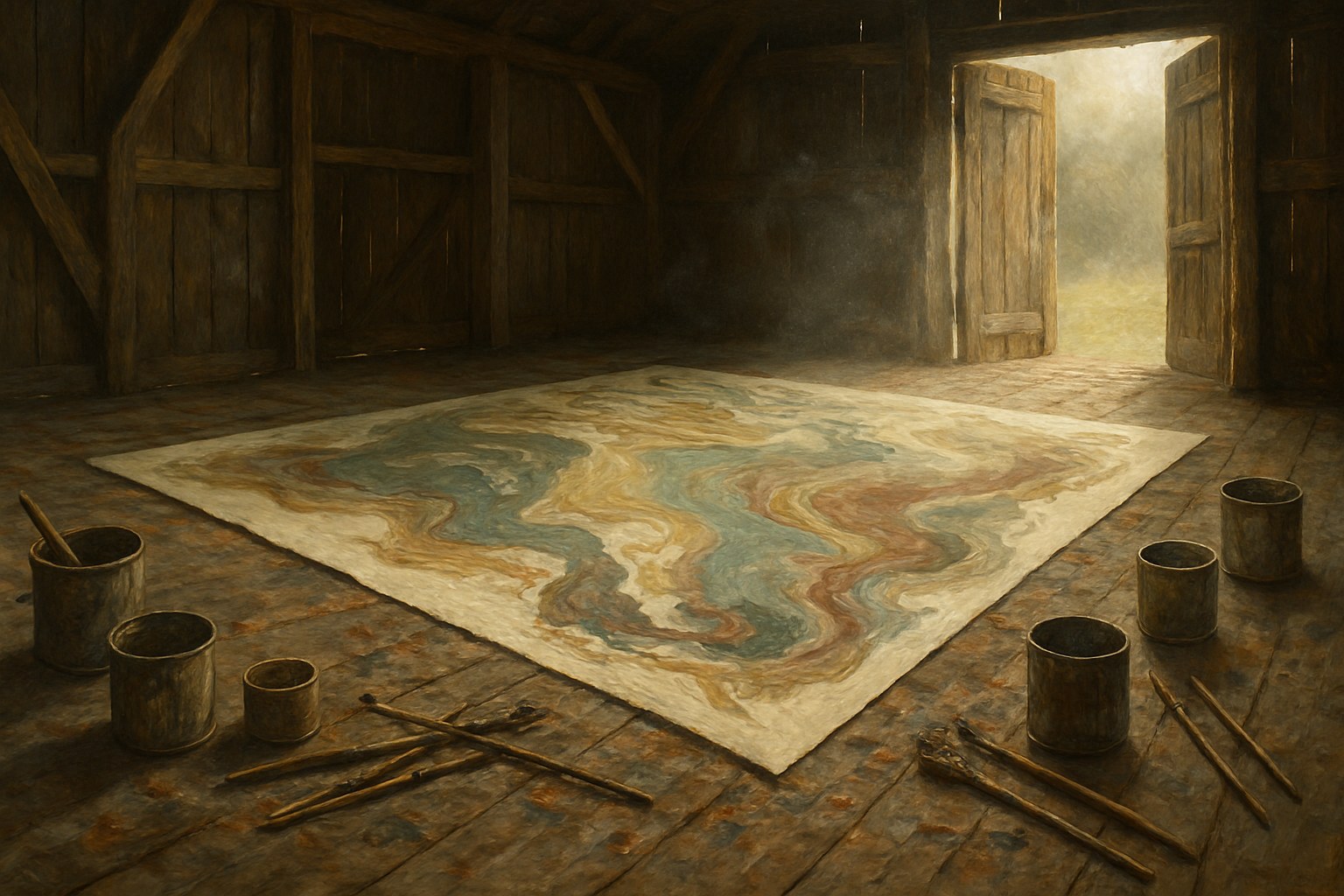
The break came between 1947 and 1950 in a converted barn behind a farmhouse in Springs, on the eastern end of Long Island, where he had moved with the painter Lee Krasner after they married in 1945. He tacked unstretched canvas to the floor and worked around it, pouring and flicking commercial enamel from sticks and hardened brushes, building layer over layer. He disliked the word drip. He said there was no accident, that he could control the flow, and that once he was inside the painting he knew what he was doing. The results were unlike anything then being made anywhere.
Fame arrived in a single stroke. In August 1949 Life magazine ran a spread asking whether Jackson Pollock was the greatest living painter in the United States, and a difficult experimental artist became a national celebrity, photographed in denim with a cigarette hanging from his lip. Hans Namuth's photographs and film of him working, made in 1950, fixed the image permanently and also unsettled him — he felt he was performing. The great pour paintings of those years, One and Autumn Rhythm and Number 1, 1950, were made by a man who had stopped drinking for about two years.
He started again in late 1950 and the work grew erratic. He returned to black pourings, then to figures, then painted very little at all. On the night of August 11, 1956, driving drunk near his home in Springs, he crashed the car and was killed at forty-four, along with a young passenger, Edith Metzger. The mythology that grew afterward — the cowboy genius, the American Rimbaud — has often obscured how deliberate the paintings are. Krasner, who set aside her own career for years to manage his, outlived him by twenty-eight and built the reputation that survives.

| Born | 1912, Cody, Wyoming |
| Teacher | Thomas Hart Benton, Art Students League |
| Depression work | The WPA Federal Art Project |
| Pour paintings | 1947-1950, in a barn at Springs, New York |
| Made famous by | Life magazine, August 1949 |
| Died | August 11, 1956, in a car crash at forty-four |
| Date | 1912-1956 |
| Location | Springs, East Hampton, New York |