Helen Keller
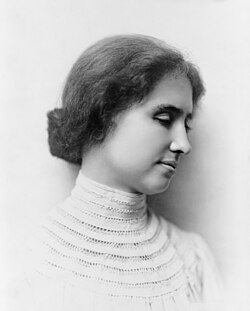
Helen Keller was 19 months old when an illness — probably scarlet fever or meningitis — left her deaf and blind. She spent the next five years in a world of darkness and silence, communicating through a private system of touch-signs she developed with the family cook's daughter, consumed by frustrations that erupted in violent rages her family couldn't manage. Then Anne Sullivan arrived from Boston in April 1887, and within a month, at a water pump in Tuscumbia, Alabama, spelled W-A-T-E-R into one of Keller's hands while water ran over the other. Something connected. "I knew then," Keller later wrote, "that 'w-a-t-e-r' meant the wonderful cool something that was flowing over my hand."
Keller graduated from Radcliffe College cum laude in 1904 — the first deaf-blind person to earn a bachelor's degree anywhere — having learned to read in Braille, write on a typewriter, speak in a voice that required patient listening to understand, and lip-read by pressing her fingers to a speaker's lips and throat. Her autobiography "The Story of My Life," published when she was 23, became an international sensation that has never gone out of print. She went on to write 12 books, lecture throughout the world, and become one of the most recognized Americans of her century.
The Helen Keller of popular mythology — the triumphant child at the pump — obscures the adult she became. Keller was a committed socialist, supported Eugene Debs's presidential campaigns, opposed U.S. entry into World War I, co-founded the ACLU, campaigned for women's suffrage, and organized for workers' rights in terms that made newspapers deeply uncomfortable. When she expressed political opinions, publications that had celebrated her courage suggested she was being manipulated by radical handlers. Her 1916 response was precise: "So long as I confine my activities to social service and the blind, they compliment me extravagantly... But when it comes to probe into the cause of blindness and other industrial diseases, I am a dangerous bomb."

| Born | June 27, 1880 — Tuscumbia, Alabama |
| Died | June 1, 1968 — Westport, Connecticut |
| Illness | Scarlet fever or meningitis, age 19 months (c. 1882) |
| Teacher | Anne Sullivan, beginning April 5, 1887 |
| Education | Radcliffe College, cum laude, 1904 |
| Key work | "The Story of My Life" (1903) |
| Co-founded | American Civil Liberties Union (ACLU), 1920 |
| Political affiliation | Socialist Party; pacifist; suffragist |
| Years | 1880–1968 |
| Location | Tuscumbia, Alabama |