The United Auto Workers
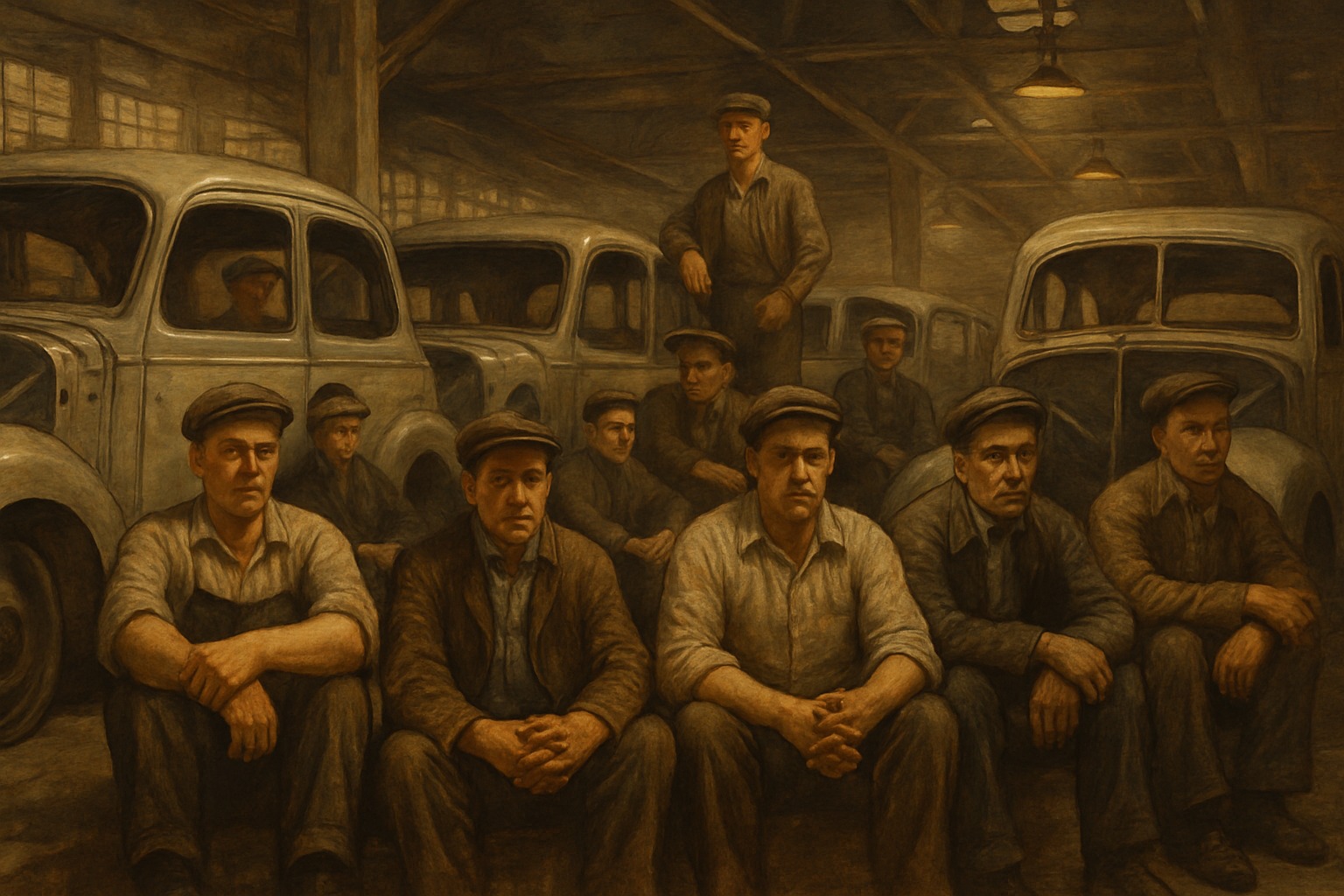
The United Auto Workers was born in 1935 to do what the old craft unions would not — organize the assembly line. Chartered under the new Congress of Industrial Organizations, the UAW aimed to unite everyone in an auto plant, from the skilled toolmaker to the man tightening bolts on the line, into a single industrial union. It faced the most powerful corporations in America, and it won its foothold through one of the boldest tactics in labor history.
In the winter of 1936 to 1937, autoworkers in Flint, Michigan, occupied General Motors plants and simply refused to leave. The sit-down strike, which held the factories hostage without violence to the machinery, paralyzed GM for forty-four days and forced the giant to recognize the UAW — a stunning victory that sent industrial unionism surging across the country. Ford held out longer, and in 1937 its security men beat UAW organizers at the Battle of the Overpass, but even Ford recognized the union in 1941.
Under Walter Reuther, who led the union from 1946, the UAW turned its bargaining power into a blueprint for middle-class life. Its 1950 contract with GM, dubbed the Treaty of Detroit, traded labor peace for employer-paid pensions, health insurance, and wage increases tied to the cost of living. Through pattern bargaining, the gains it won from one automaker spread to the others and, by example, to much of American industry, helping make the postwar factory job a ladder into the middle class.
The union's fortunes tracked the industry it organized. As foreign competition, automation, and plant closures shrank American auto manufacturing, UAW membership fell far from its mid-century peak, and the near-collapse of the automakers in the 2008 financial crisis forced painful concessions. Yet the union endured and, in recent years, mounted new organizing drives beyond Detroit. Its history remains the clearest single case study of how organized labor built — and struggled to hold — the American middle class.

| Founded | 1935 (under the CIO) |
| Breakthrough | Flint sit-down strike vs. GM, 1936–37 |
| Ford | Recognized the UAW in 1941 |
| Leader | Walter Reuther (president from 1946) |
| Landmark contract | "Treaty of Detroit" with GM, 1950 |
| Method | Pattern bargaining across the automakers |
| Date | Founded 1935 |
| Location | Detroit, Michigan |