The Hot Dog
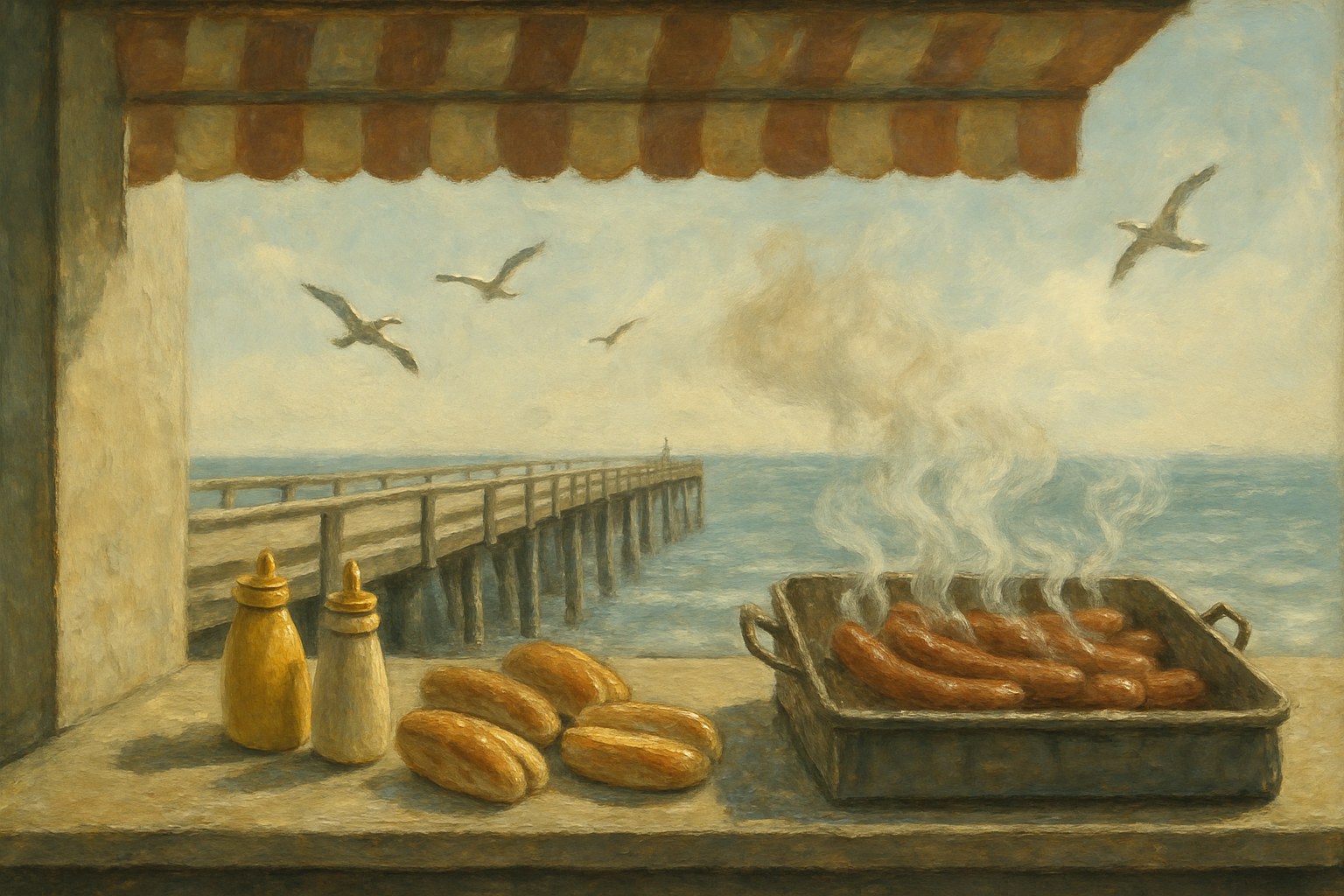
German immigration made it possible. The wave of arrivals from the German states in the middle of the nineteenth century brought butchers, and with them the fine emulsified pork and beef sausages of Frankfurt and Vienna — the frankfurter and the wiener, both names still attached to the thing. In American cities those butchers sold from shops and from pushcarts, and somewhere in the 1860s and 1870s the sausage acquired a split roll, which solved the practical problem of holding something hot without a plate.
Coney Island is where it became an institution. Charles Feltman, a German-born baker, was selling sausages in rolls from a pie wagon on the Brooklyn sand by 1867 and built the trade into a large beachfront restaurant. In 1916 one of his employees, a Polish Jewish immigrant named Nathan Handwerker, opened a stand across the way and undercut him at five cents. Nathan's Famous outlasted Feltman's and most of the amusement parks around it, and the eating contest it promotes has outlasted nearly everything else on the boardwalk.
The ballpark carried it the rest of the way. Sausages were being sold at American baseball grounds by the 1890s, and the food fit the game — one hand, no utensils, eaten sitting down across three unhurried hours. A widely repeated story credits the sports cartoonist Tad Dorgan with coining hot dog at a New York ballpark, but no such cartoon has ever been produced, and the term appears earlier in American college slang, where it carried a joke about what might be inside the sausage.
Regional versions hardened into rules that locals enforce. Chicago dresses a poppy-seed bun with mustard, relish, chopped onion, tomato, a pickle spear, sport peppers, and celery salt, and refuses ketchup outright. Detroit and Flint serve coneys under a fine-ground meat sauce. New York carts use sauerkraut and a red onion sauce. Rhode Island has its New York System, Arizona its bacon-wrapped Sonoran. For a food sold everywhere at low cost, the hot dog has kept an unusual amount of local stubbornness.


| Ancestors | The Frankfurt and Vienna sausages of German butchers |
| Coney Island | Charles Feltman from 1867, Nathan Handwerker from 1916 |
| Ballparks | Sold at American baseball grounds by the 1890s |
| The name | The Tad Dorgan cartoon story is unsupported |
| Regional rules | Chicago, Detroit coneys, Rhode Island, the Sonoran |
| Date | 1867 to today |
| Location | Coney Island, Brooklyn, New York |