William Rehnquist
William Rehnquist came to the Court with a record that made him a target. As a law clerk to Justice Robert Jackson in 1952 he had written a memo arguing that Plessy v. Ferguson was right and should be reaffirmed, which he later said reflected Jackson's views rather than his own. He had worked in Arizona Republican politics and served in Richard Nixon's Justice Department, where he defended broad executive power. Nixon nominated him in 1971, and he was confirmed sixty-eight to twenty-six.
In his early years he was so often alone in dissent on a Court still shaped by Earl Warren that his clerks gave him a Lone Ranger doll. He argued for narrower readings of federal power, for more room for the states, and for fewer restraints on police and prosecutors. In 1986 Ronald Reagan elevated him to Chief Justice, and he was confirmed after a contentious fight, sixty-five to thirty-three.
As Chief he ran the Court efficiently and steered a slow revival of federalism. In United States v. Lopez in 1995 the Court struck down a federal law on the ground that it exceeded Congress's commerce power, the first such ruling in nearly sixty years, and later cases limited the reach of federal law over the states. He was not predictable on every question. In 2000 he wrote the opinion reaffirming Miranda, a decision he had long criticized, on the ground that it had become part of the national culture.
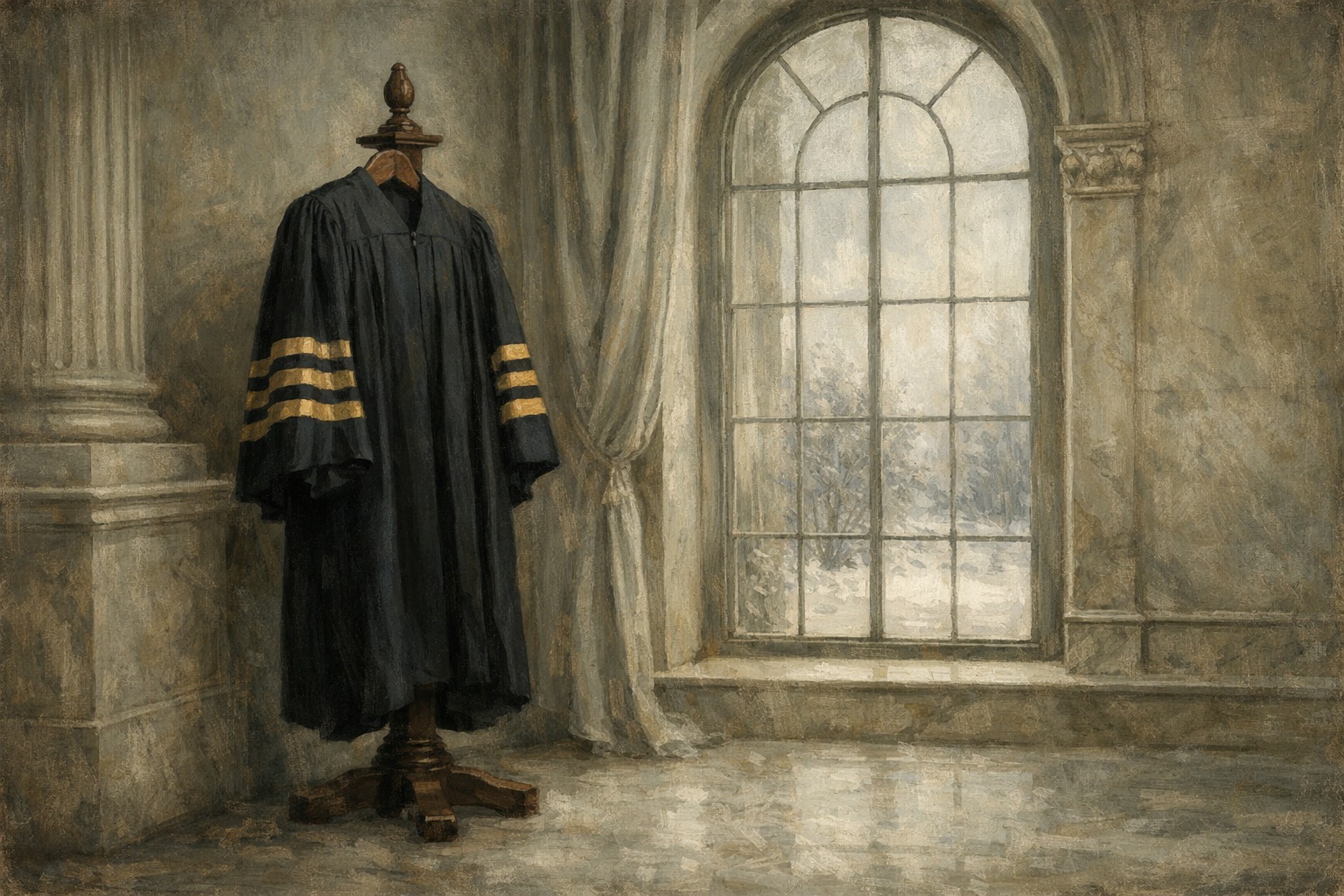
In 1999 Rehnquist presided over the impeachment trial of Bill Clinton in the Senate, wearing a robe he had decorated with four gold stripes on each sleeve, inspired by a Gilbert and Sullivan operetta. He joined the majority in Bush v. Gore the following year. He served as Chief Justice for nineteen years and died in office in September 2005, after thirty-three years on the Court. His former clerk John Roberts succeeded him.
| Served | Associate Justice 1972–1986, Chief Justice 1986–2005 |
| Appointed by | Richard Nixon, elevated by Ronald Reagan |
| Chief Justice | The 16th |
| Signature case | United States v. Lopez, 1995 |
| Presided over | The 1999 impeachment trial of Bill Clinton |
| Succeeded by | John G. Roberts Jr., his former clerk |
| Date | 1924–2005 (Justice 1972–2005) |