Clarence Thomas
Associate Justice since 1991, the second Black justice and the longest-serving member of the current Court
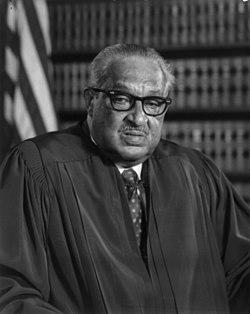
Clarence Thomas has served on the Supreme Court since 1991, making him the longest-serving member of the current Court. He was born on June 23, 1948, in Pin Point, Georgia, a small Gullah-speaking community near Savannah, and was raised largely by his grandparents after his parents separated. He attended Catholic schools and spent time in a seminary before graduating from the College of the Holy Cross in 1971 and Yale Law School in 1974. He then worked for Missouri Attorney General John Danforth, as a lawyer for the Monsanto Company, and on Danforth's U.S. Senate staff before joining the Reagan administration in 1981. His 2007 memoir, My Grandfather's Son, credits his grandfather's discipline with shaping his outlook.
Thomas served as assistant secretary for civil rights at the Department of Education and then, from 1982 to 1990, as chairman of the Equal Employment Opportunity Commission. President George H. W. Bush appointed him to the U.S. Court of Appeals for the D.C. Circuit in 1990 and in 1991 nominated him to succeed Thurgood Marshall, the Court's first Black justice. The confirmation hearings became a national event when law professor Anita Hill, who had worked for him at two federal agencies, testified that he had sexually harassed her. Thomas denied the allegations and called the hearings "a high-tech lynching." The Senate confirmed him 52 to 48 on October 15, 1991.
On the Court, Thomas is known as an originalist who reads the Constitution according to its meaning when it was adopted and who is often willing to reconsider long-standing precedents. He wrote the majority opinion in New York State Rifle & Pistol Association v. Bruen (2022), which held that the Second Amendment protects carrying a handgun in public for self-defense, and he dissented in Obergefell v. Hodges (2015). For about ten years, ending in 2016, he asked no questions at oral argument; he has questioned lawyers regularly since the Court changed its argument format in 2020. Reporting in 2023 on gifts and travel from wealthy friends drew calls for stricter ethics rules, and the Court adopted a formal code of conduct that November.
Related entries


Featured in these guides
Across the Brief network
People in this entry, on BriefPeople