Herman Melville
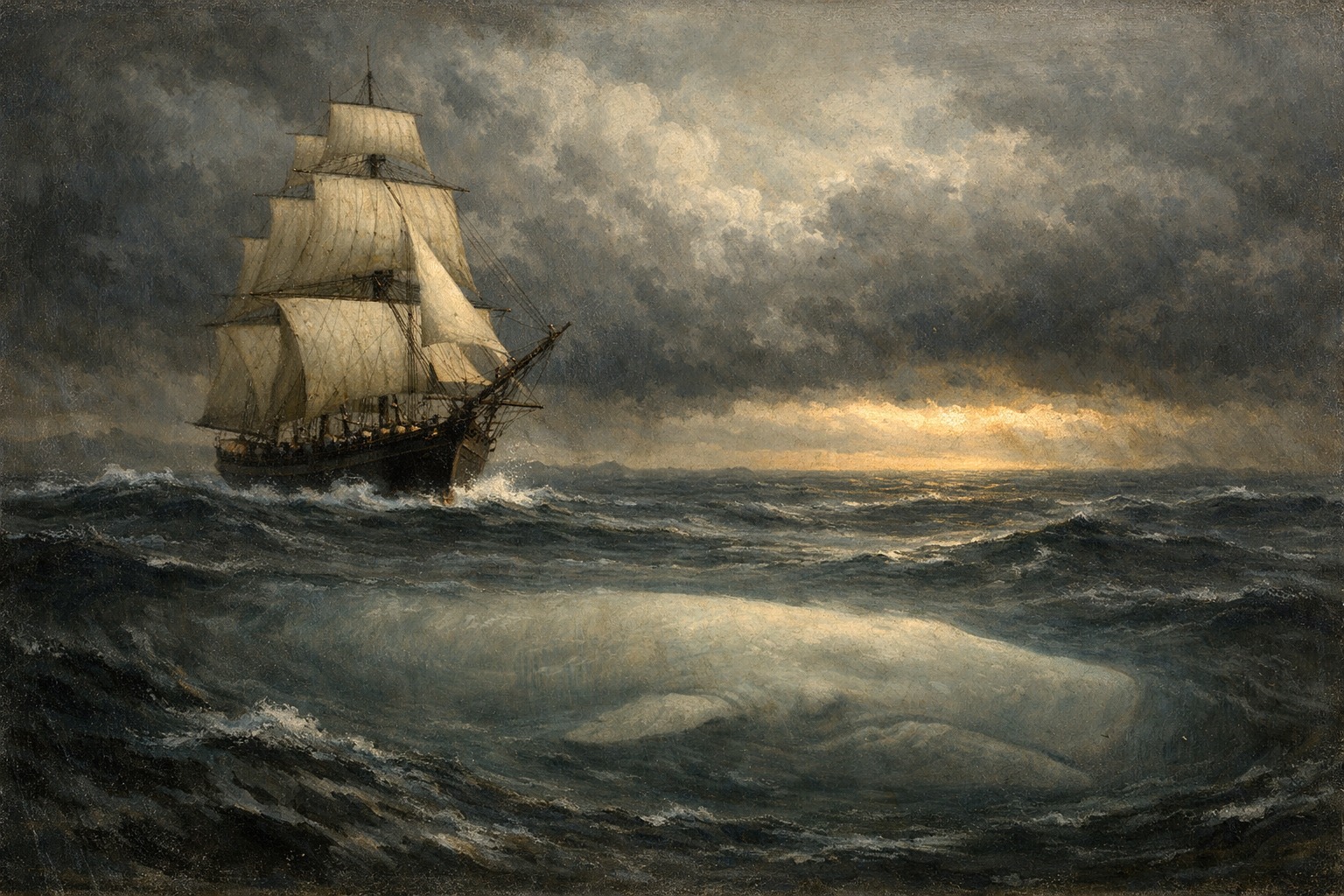
Herman Melville's father died bankrupt when he was twelve, and the boy left school to work as a clerk, a farmhand, and a teacher. In January 1841, at twenty-one, he shipped out of Fairhaven, Massachusetts, on the whaler Acushnet. Eighteen months later he deserted in the Marquesas Islands, lived for some weeks in a valley of the Typee people, and drifted through the Pacific on other ships before returning home in 1844 aboard a navy frigate.
He turned the experience into Typee, published in 1846, an account of life among the islanders that was part memoir and part invention, and its sequel Omoo. They made him famous as the man who had lived among cannibals. But Melville wanted to write something deeper. Influenced by Shakespeare and by his new friendship with Nathaniel Hawthorne, he reworked a whaling adventure into Moby-Dick, published in 1851.
The novel follows Captain Ahab's monomaniacal hunt for the white whale that took his leg, narrated by a sailor who asks to be called Ishmael. It mixes adventure with sermons, encyclopedic chapters on whales, stage dialogue, and philosophical speculation, and readers and critics were baffled. It sold only a few thousand copies in his lifetime. His next novels did worse, and the stories that followed, including Bartleby, the Scrivener, found few readers.
Melville spent nineteen years as a customs inspector on the New York docks, wrote poetry about the Civil War, and died in 1891 nearly forgotten. The centennial of his birth in 1919 began a revival, and the manuscript of Billy Budd, found among his papers, was published in 1924. Within a generation Moby-Dick was treated as a candidate for the great American novel, and its opening line became one of the most recognized in literature.

| Born | New York City, 1819 |
| At sea | Whaler Acushnet, 1841–1842, and the Pacific until 1844 |
| First success | Typee, 1846 |
| Masterpiece | Moby-Dick, 1851, dedicated to Nathaniel Hawthorne |
| Later career | New York customs inspector, 1866–1885 |
| Revival | Began with the 1919 centennial, Billy Budd published 1924 |
| Date | 1819–1891 |
| Location | New York City |