Rock and Roll
By the early 1950s two Southern musics that had been sold separately for thirty years were audibly converging. Rhythm and blues, the electrified dance music made for Black urban audiences, and country, the string-band music of white Southerners, shared a rhythmic vocabulary and increasingly shared listeners, since radio signals do not observe segregation ordinances. Disc jockeys such as Alan Freed in Cleveland played Black records to white teenagers who called in asking for more, and gave the mixture a name borrowed from blues slang. The audience assembled itself before the industry knew what to do with it.
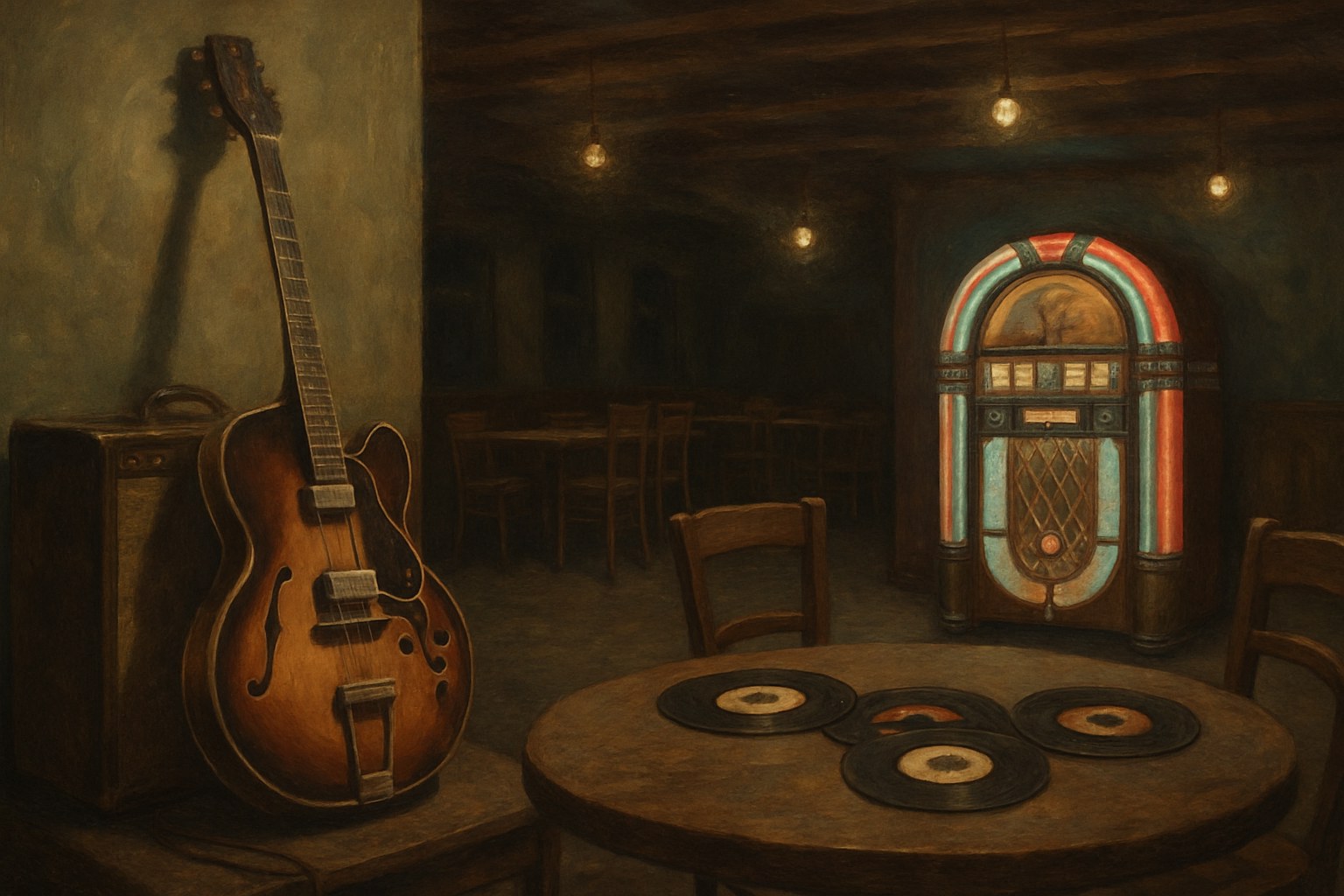
Sam Phillips recorded Black artists at his small Memphis studio, Sun Records, and by his own later account wanted to find a white singer who could deliver that feeling to a segregated market. In July 1954 Elvis Presley cut That's All Right at Sun, and within two years the sound was national. The technology fit the moment exactly. The seven-inch 45 was cheap enough for a teenager to buy with pocket money, jukeboxes carried the hits into every diner, and a postwar economy had produced, for the first time, an adolescent consumer class with income of its own.
Who got credit and who got paid became the argument that never closed. Chuck Berry, Little Richard, Fats Domino, and Big Joe Turner were architects of the form, but white cover versions of Black records routinely outsold and outearned the originals, and songwriting credits were often signed away for a flat fee by artists with no lawyer. Some Black musicians described the arrangement plainly as theft. Others, Little Richard and Berry among them, described a more tangled reality of mutual admiration and borrowing inside an industry that cheated nearly everyone and cheated Black artists worse.
The generational rupture was real and the reaction to it was fierce. Clergy, school boards, and city councils denounced the music, some of them objecting explicitly because it drew Black and white teenagers into the same halls. Records were burned, concerts were banned, and none of it worked. Rock and roll established the teenager as a cultural and commercial force, turned the record album into a form of expression within a decade, and set the terms on which American popular culture would be exported for the rest of the century.


| Ingredients | Rhythm and blues plus country and gospel |
| Named by | Disc jockey Alan Freed, from blues slang |
| Studio | Sun Records, Memphis — Sam Phillips |
| Technology | The seven-inch 45, the jukebox, and radio |
| Architects | Chuck Berry, Little Richard, Fats Domino, Big Joe Turner |
| Backlash | Record burnings, concert bans, and objections to mixed audiences |
| Date | From the mid-1950s |
| Location | Memphis, Tennessee |