The Pacemaker
On Halloween night in 1957 a storm knocked out power across much of Minneapolis and the counties around it for three hours. At the University of Minnesota, the surgeon C. Walton Lillehei was keeping children alive after open-heart operations with external pacemakers — bulky units that plugged into the wall and delivered a pulse down a wire stitched directly to the heart muscle. When the current stopped, one of his young patients died. Lillehei called the man who repaired the hospital's equipment and told him to build something that did not depend on the grid.
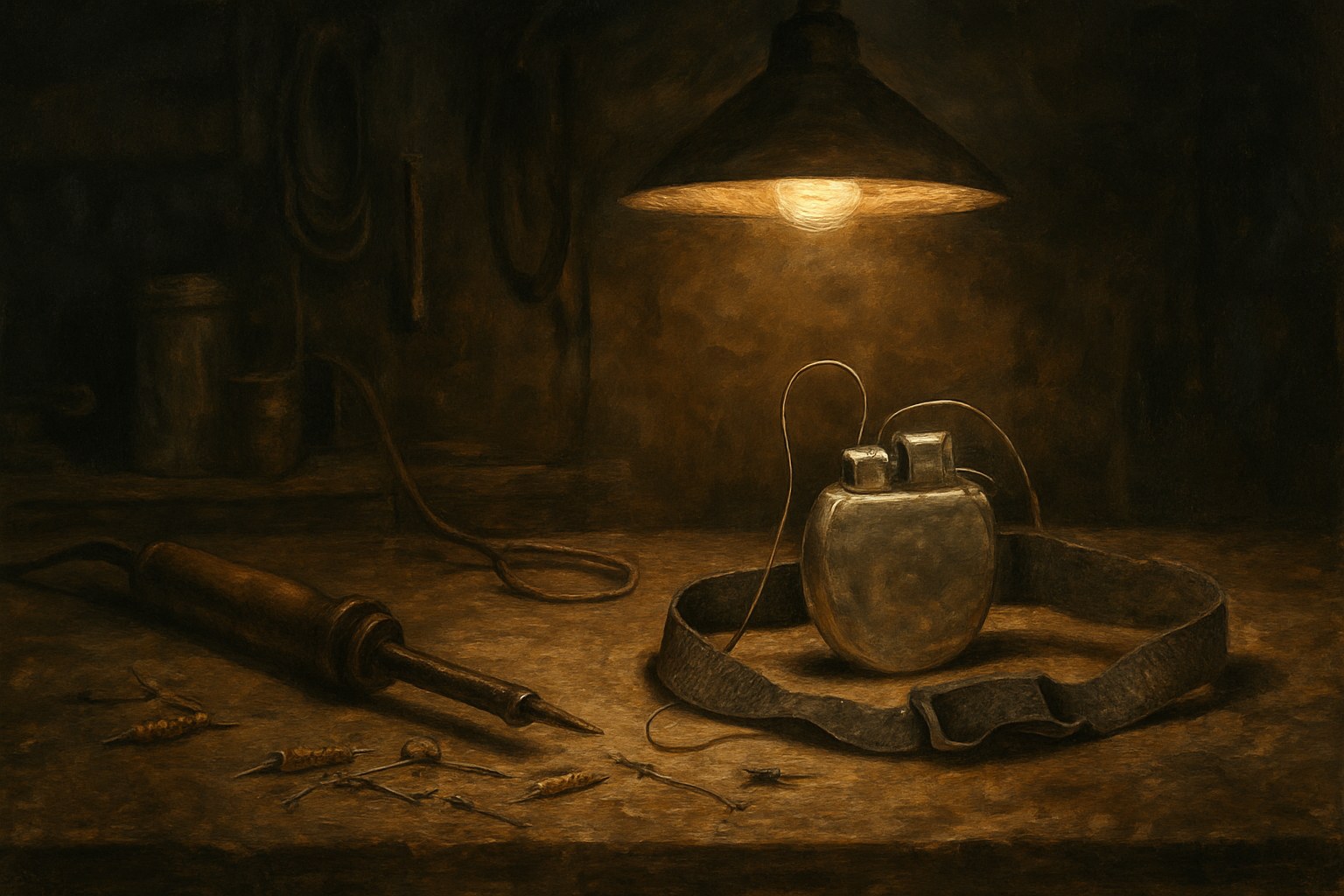
That man was Earl Bakken, an electrical engineer who ran a medical equipment repair business out of a garage in northeast Minneapolis with his brother-in-law. The company was called Medtronic and it had almost no money. Bakken found a circuit diagram for a transistorized metronome in a hobbyist electronics magazine, adapted it, and packed it into a small metal case with a battery and a strap. He had a working prototype in about four weeks. Lillehei was using it on a child within days. It was the first practical wearable, battery-powered pacemaker.
Making one small enough to live inside a chest was a separate problem, and it was solved by mistake. In 1956 Wilson Greatbatch, an engineer in Buffalo, New York, was building an oscillator to record heart sounds and reached into a box for a resistor. He installed the wrong value, and the circuit began emitting a slow rhythmic pulse instead of recording anything. He recognized the rhythm immediately. Working in a barn behind his house, he spent two years shrinking the device and sealing it against body fluids, and in 1960 the surgeon William Chardack implanted the result in ten patients in Buffalo.
A Swedish team led by Rune Elmqvist and Ake Senning had implanted a pacemaker in 1958, but it failed within hours and never went into production. The Greatbatch-Chardack unit did. Battery life was the last obstacle, and Greatbatch solved that as well, developing the lithium-iodide cell that let a pacemaker run for a decade instead of two years. More than a million are implanted worldwide each year. The device also established an entire category — defibrillators, nerve stimulators, cochlear implants — of electronics that live inside the body and keep it running.
| The trigger | A three-hour Minneapolis blackout, October 31, 1957 |
| Wearable unit | Earl Bakken, Medtronic — built in about four weeks |
| Surgeon | C. Walton Lillehei, University of Minnesota |
| Implantable | Wilson Greatbatch, from an accidentally wrong resistor |
| First implants | 1960, by William Chardack in Buffalo, New York |
| Battery | Greatbatch's lithium-iodide cell, a decade of life |
| Date | 1957-1960 |
| Location | Minneapolis, Minnesota |