The Artificial Heart
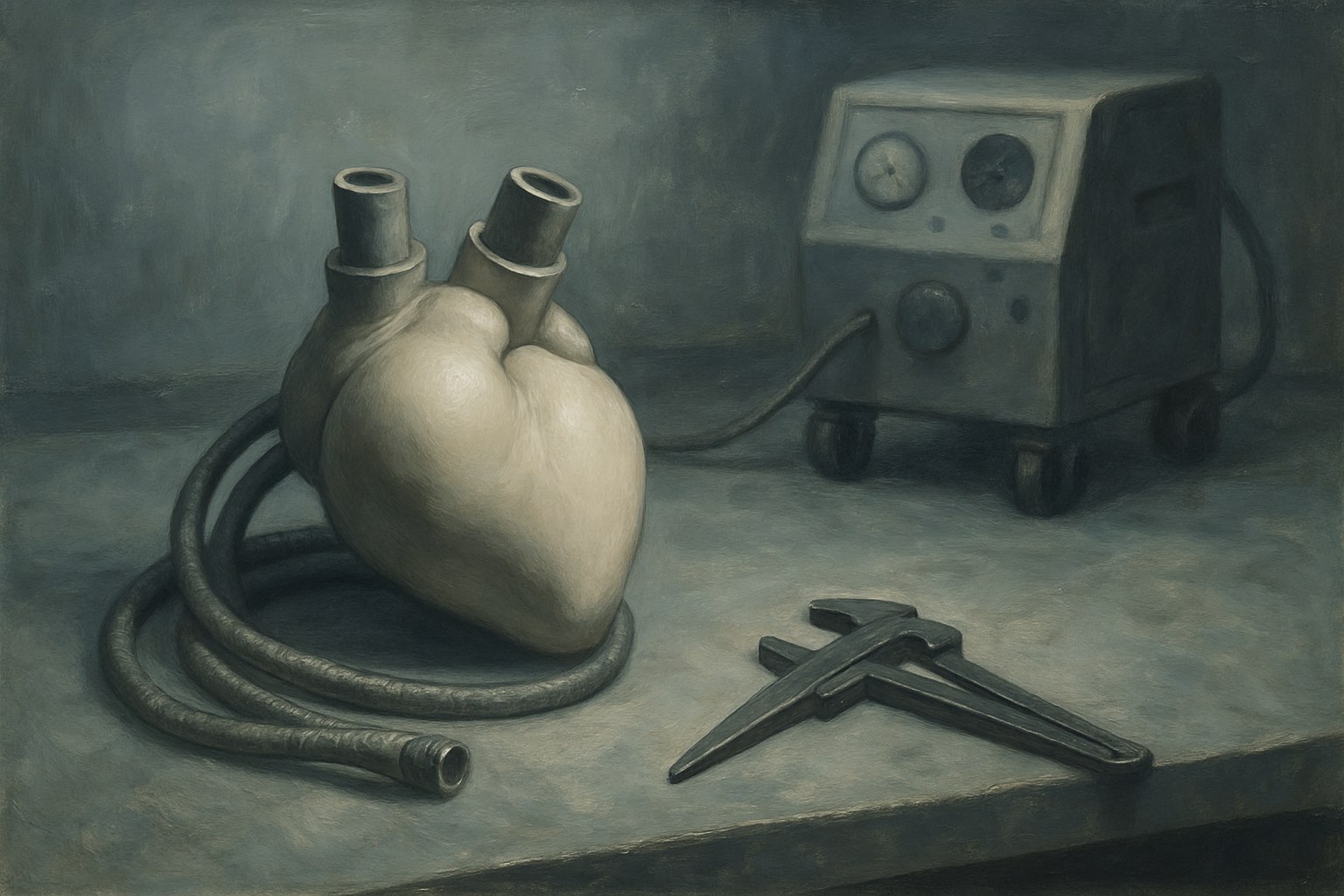
Willem Kolff, having already built the first artificial kidney, moved to the United States and set out to build an artificial heart. His laboratory at the University of Utah spent two decades on the problem: a pump that had to beat roughly one hundred thousand times a day, indefinitely, without clotting the blood it moved or wearing through its own valves. By the early 1980s the device carried the name of Robert Jarvik, a young member of the team who had refined its fit to the human chest. It was called the Jarvik-7, and it ran on compressed air fed through two hoses from a console the size of a refrigerator.
The first recipient was Barney Clark, a sixty-one-year-old retired dentist from Seattle dying of cardiomyopathy and considered too old for a transplant. The surgeon William DeVries operated at the University of Utah Medical Center overnight on December 1 and 2, 1982. Clark survived the operation and lived 112 days, tethered to the console for every one of them. It was not a recovery. He suffered seizures, kidney failure, and a broken valve that required a second operation, and at one point he asked whether he might be allowed to die. He never left the hospital.
The press coverage was relentless and the ethical objections were immediate. Clark's eleven-page consent form was picked apart by bioethicists who asked whether a desperately ill man could meaningfully refuse. Critics questioned what the device was actually for if it produced months of suffering rather than years of life, and whether the same money spent on prevention would save more people. Three more permanent implants followed — William Schroeder lived 620 days but suffered a series of strokes — and in 1990 the FDA withdrew approval of the Jarvik-7 for permanent use.
The technology itself did not disappear. It was reconceived as a bridge — a way to hold a patient steady for weeks or months until a donor heart became available — and in that role it was approved again in 2004 and has been used thousands of times since. The larger legacy went to the left ventricular assist device, a smaller pump that helps a failing heart rather than replacing it, and which now supports some patients for years. The fully self-contained replacement heart that Kolff imagined has still not been built.
| Device | The Jarvik-7, from Willem Kolff's Utah laboratory |
| Patient | Barney Clark, a retired dentist, aged 61 |
| Surgeon | William DeVries, University of Utah, December 1-2, 1982 |
| Survival | 112 days, tethered to an external air console |
| FDA | Permanent-use approval withdrawn in 1990 |
| Today | Approved 2004 as a bridge to transplant |
| Date | December 1982 |
| Location | Salt Lake City, Utah |