Dialysis
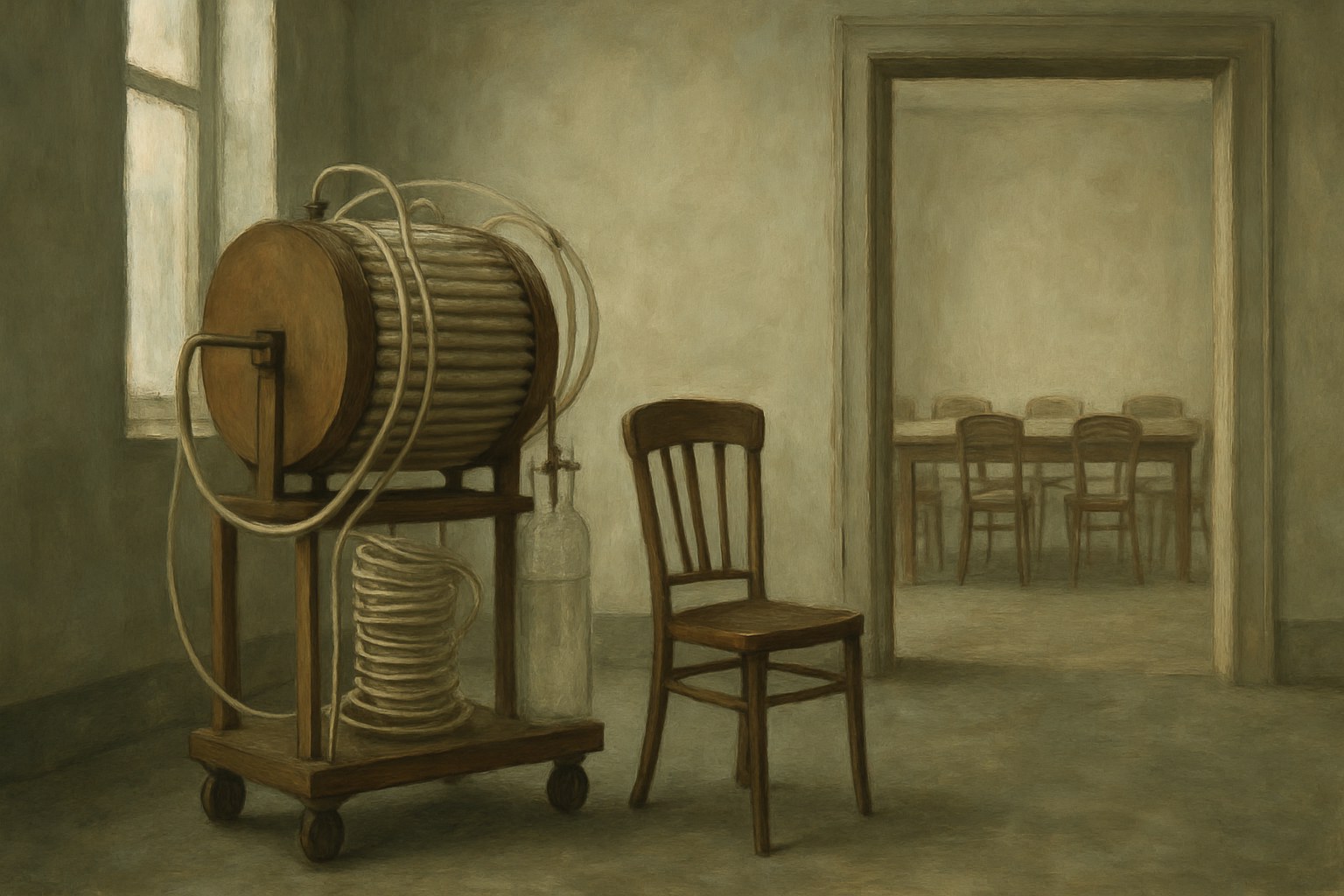
Kidney failure was a death sentence with a fully understood mechanism. The organs filter waste out of the blood, and when they stop the waste accumulates until it poisons the body — a matter of days or a few weeks. Physicians could describe the process precisely and do nothing whatever about it. During the German occupation of the Netherlands, a young internist named Willem Kolff, working in a small hospital in Kampen and scavenging what materials he could find, built a machine to do the filtering outside the body: sausage casing wound around a wooden drum that rotated through a bath of salt solution.
Kolff's first fifteen patients died. The sixteenth, a woman in her sixties imprisoned as a Nazi collaborator, regained consciousness in September 1945 and lived. He gave his machines away rather than patent them, shipping them to hospitals in Europe and North America, and emigrated to the Cleveland Clinic in 1950. But the artificial kidney could be used only a handful of times on any one patient. Each session meant cutting into an artery and a vein and destroying both, and a person runs out of usable vessels quickly. Dialysis could rescue someone from a temporary crisis. It could not treat a chronic disease.
Belding Scribner, at the University of Washington, solved that in 1960 with something close to absurdly simple. Working with the engineer Wayne Quinton, he built a U-shaped shunt of Teflon that stayed permanently in the forearm, joining an artery to a vein and offering a port that could be opened for each treatment and closed again afterward. His first patient, a machinist named Clyde Shields, lived another eleven years. Long-term dialysis was suddenly possible, and for a while Seattle ran the only center in the world that offered it.
Which meant somebody had to choose. The center's anonymous Admissions and Policy Committee — seven laypeople including a lawyer, a minister, a banker, and a housewife — reviewed applicants and decided who would be treated and who would be sent home to die, weighing marital status, church membership, children, and net worth. A Life magazine article in November 1962 exposed the process and appalled the country, and the argument that followed is generally counted as a founding moment of American bioethics. Congress resolved it in 1972 by amending the Social Security Act to cover end-stage renal disease under Medicare for anyone who needed it, at any age. It remains the only illness for which the United States guarantees universal coverage.


| Inventor | Willem Kolff, Kampen, the Netherlands, 1943-1945 |
| First survivor | September 1945, after fifteen failures |
| The shunt | Belding Scribner and Wayne Quinton, Seattle, 1960 |
| The God Committee | Seattle's lay Admissions and Policy Committee, 1962 |
| Exposed by | Life magazine, November 1962 |
| Coverage | Medicare ESRD amendment, 1972 — universal, at any age |
| Date | 1943-1972 |
| Location | Seattle, Washington |