The Willis Tower
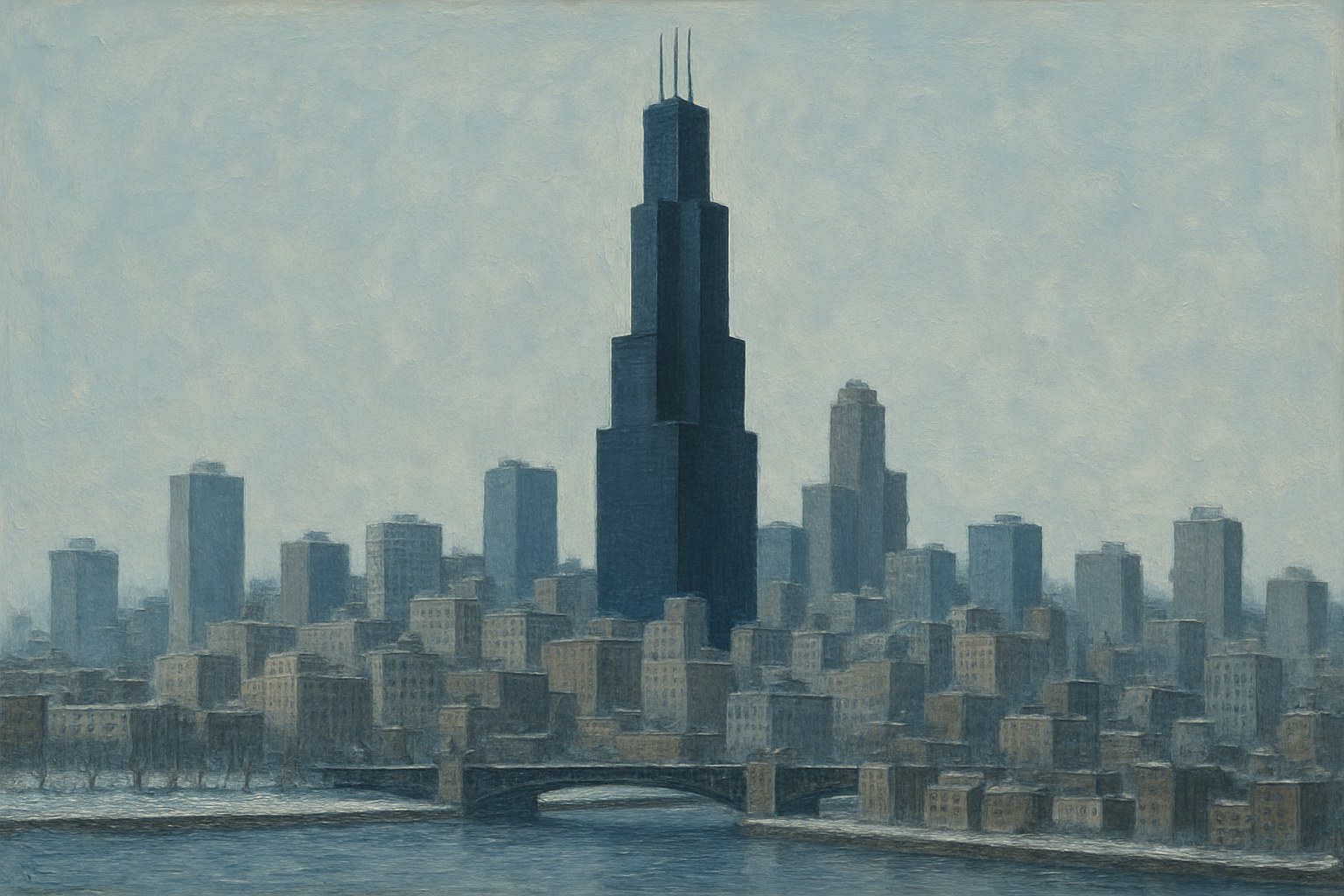
Sears, Roebuck and Company was the largest retailer in the world at the end of the 1960s, and its offices were scattered across Chicago. The company decided to gather them into a single tower on the western edge of the Loop, large enough for thirteen thousand employees with room to grow into. The architects at Skidmore, Owings and Merrill were asked for something enormous, and they faced the problem that had constrained every tall building since the 1880s: wind, not weight, sets the practical limit on height.
Fazlur Rahman Khan, a Bangladeshi-born structural engineer at the firm, had spent the 1960s working out a family of solutions in which the exterior of a building behaves as a rigid tube. For Sears he bundled nine of them — nine square tubes, each seventy-five feet on a side, rising together from a single base. Two stop at the fiftieth floor, two more at the sixty-sixth, three at the ninetieth, and two continue to the one hundred and eighth, which produces the stepped profile and uses far less steel than a conventional frame of the same height.
At one thousand four hundred and fifty feet to the roof it passed the World Trade Center and held the title of tallest building in the world for twenty-five years, until the Petronas Towers in Kuala Lumpur claimed it in 1998 on the contested basis of their decorative spires. The observation deck on the one hundred and third floor, later fitted with glass boxes cantilevered out over Wacker Drive, became one of Chicago's busiest attractions. Sears itself left the building in the 1990s as the company slid into decline.
In 2009 the London insurance broker Willis Group Holdings leased several floors and took the naming rights, and the Sears Tower officially became the Willis Tower — a change many Chicagoans have simply declined to make, four decades of habit outweighing a lease clause. The structure matters more than the name. Khan's bundled tube made supertall construction economical, and nearly every building above a hundred stories put up anywhere since works from the principle he demonstrated on Wacker Drive.

| Completed | 1973, as the Sears Tower |
| Architects | Skidmore, Owings and Merrill |
| Engineer | Fazlur Rahman Khan |
| Structure | Nine bundled square tubes, stepping back with height |
| Height | 1,450 feet to the roof, 108 stories |
| Renamed | Willis Tower, 2009 |
| Date | Completed 1973 |
| Location | Chicago, Illinois |