NOAA
By the late 1960s the federal government studied the ocean and the atmosphere from a dozen scattered offices that rarely spoke to one another. A presidential commission chaired by Julius Stratton reported in 1969 that the arrangement wasted money and missed the point, since the sea and the air are a single system. The commission wanted an independent agency, a wet counterpart to NASA. Richard Nixon instead folded the pieces into the Department of Commerce, and on October 3, 1970, the National Oceanic and Atmospheric Administration came into being.
What was folded in was far older than the agency. The Survey of the Coast, created by Thomas Jefferson in 1807 to chart the nation's harbors and shoals, is the oldest scientific agency in the federal government, and it brought with it two centuries of charts, a national grid of geodetic benchmarks, and a small uniformed officer corps. The Weather Bureau of 1870 brought the forecasts and the observer network. The fisheries service, descended from the fish commission of 1871, brought stock assessments and the regulation of the catch.
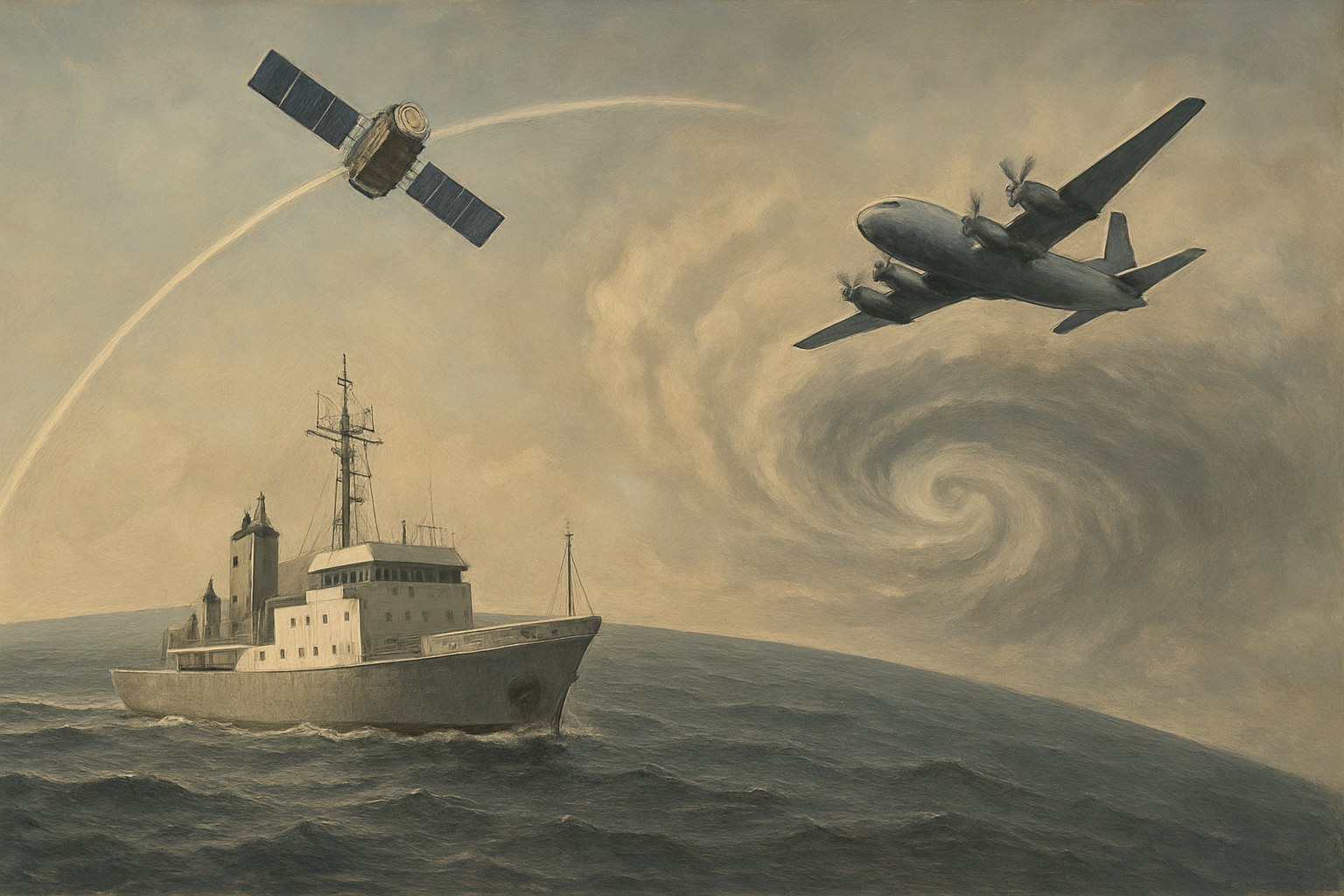
The combined agency runs the instruments that make a modern forecast possible. Geostationary satellites have watched the Western Hemisphere continuously since the mid-1970s, joined by polar orbiters that slice the atmosphere into vertical profiles of temperature and moisture. NOAA's hurricane hunters — two turboprop research aircraft that fly through the eyewall and a high-altitude jet that samples the air steering the storm — gather what no satellite can, working alongside the Air Force Reserve squadron that flies the same missions. Buoys, tide gauges, and survey ships fill in the water below.
NOAA also keeps the record. Its environmental archive in Asheville, North Carolina, holds the longest continuous run of American weather observations in existence, the raw material behind every claim that a season was unusual. That combination — the agency that issues the warning also keeps the ledger — has made NOAA a standing subject of political argument, since its temperature series and its storm forecasts are read as evidence in disputes much larger than the weather. Its founding logic has held up better than its critics have. The ocean, the atmosphere, and the fish between them are studied together because they behave as one.


| Established | October 3, 1970, under Richard Nixon |
| Department | Commerce |
| Oldest part | The Survey of the Coast, 1807 — oldest federal scientific agency |
| Also merged | The Weather Bureau (1870) and the fisheries service (1871) |
| Operates | Weather satellites, hurricane hunters, ocean survey fleet |
| Archive | The national climate record, Asheville, North Carolina |
| Date | Founded 1970 |
| Location | Silver Spring, Maryland |