The Quartering Act
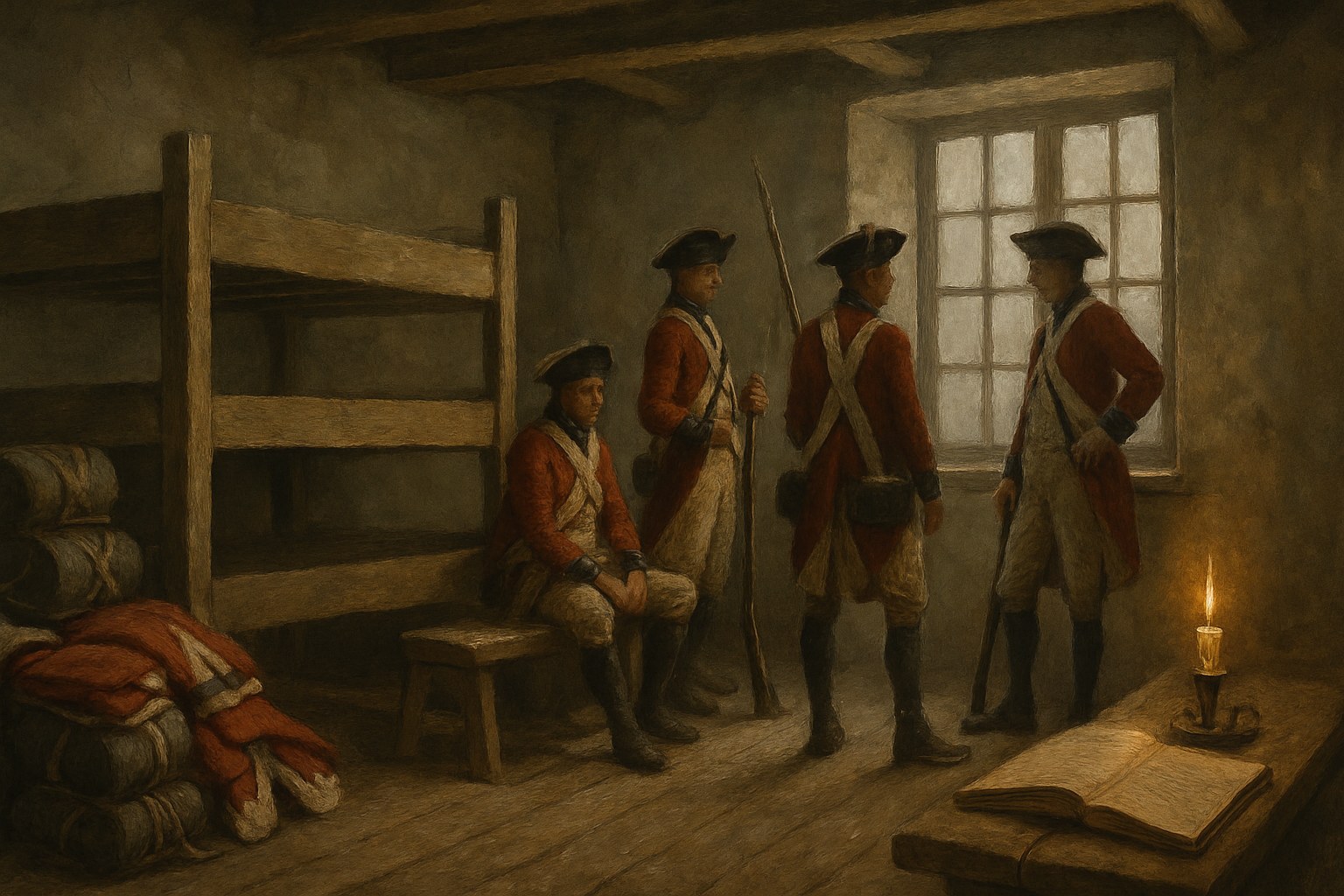
Britain kept roughly ten thousand regular soldiers in North America after 1763, nominally to garrison the frontier and the newly conquered provinces, and somebody had to lodge and feed them. General Thomas Gage, commanding in America, asked Parliament for clear authority to quarter his men where he needed them. The Quartering Act, passed a few days before the Stamp Act in March 1765, ordered colonial assemblies to provide barracks and, where barracks were lacking, to billet troops in inns, alehouses, empty buildings, and barns, supplying firewood, candles, bedding, salt, vinegar, and beer or cider.
The act did not force soldiers into occupied private homes. That belief comes later, partly from the compressed indictment in the Declaration of Independence and partly from the 1774 revision, which allowed billeting in unoccupied dwellings. What the act did do was compel elected assemblies to appropriate money on Parliament's command. That inverted the relationship colonists thought they had with their own legislatures, which had spent a century winning leverage over royal governors precisely by controlling what money was voted and when.
New York, headquarters of the army and therefore carrying the heaviest bill, supplied part of what was demanded and refused the rest. Parliament answered in 1767 with the New York Restraining Act, suspending the colony's assembly until it complied. The assembly voted the funds before the suspension took effect, so it was never enforced, but the lesson landed everywhere. A legislature could be shut down for saying no. Massachusetts faced its own version in 1768, when troops arrived at Boston and the council refused to quarter them inside the town.
The quartering dispute put soldiers and civilians into daily friction in colonial cities, competing for lodging, for space, and for off-duty work at wages that undercut local labor. That friction fed directly into the street fights that ended on King Street in March 1770. It also fixed a standing army in peacetime as a constitutional grievance rather than a practical nuisance. When Americans drafted their own Bill of Rights a generation later, the Third Amendment answered this act point by point.

| Passed | March 24, 1765 |
| Required | Colonies to house and supply British regulars |
| Did not require | Billeting in occupied private homes |
| Enforcement | New York's assembly suspended by Parliament in 1767 |
| Renewed | 1766, and broadened in 1774 |
| Legacy | Answered by the Third Amendment |
| Date | March 24, 1765 |