Immigration Act of 1924
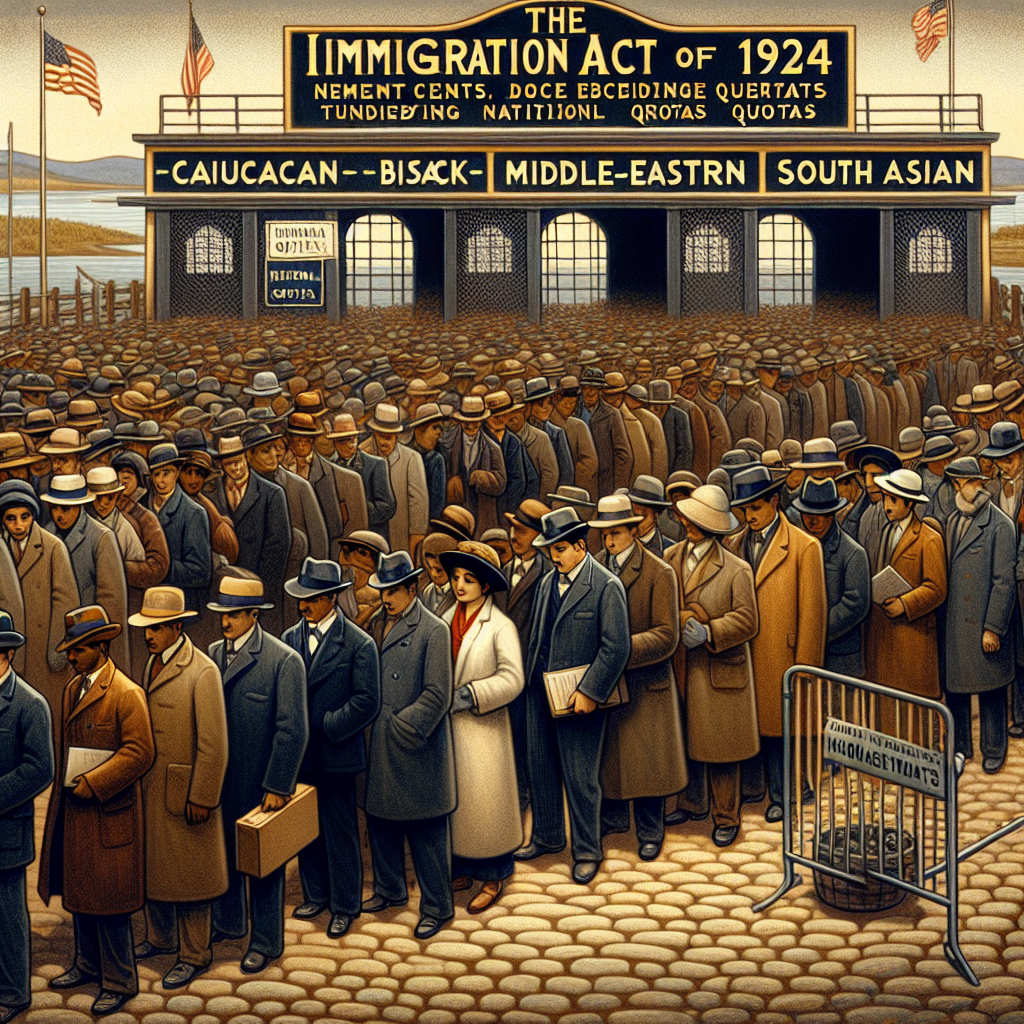
The Immigration Act of 1924 — formally the Johnson-Reed Act — established the first permanent numerical limits on immigration to the United States and created a quota system explicitly designed to freeze the racial and ethnic composition of the existing American population. Quotas for each nationality were set at two percent of that nationality's foreign-born residents in the United States as counted in the 1890 census — a baseline chosen deliberately because it predated the massive Southern and Eastern European immigration of the subsequent decades. Italians, Poles, Russians, Greeks, and Jews received tiny quotas. The British, Germans, and Scandinavians received generous ones.
The act went further than earlier restrictions. It barred virtually all immigration from Asia, extending the Chinese Exclusion Act's logic to cover Japanese, Korean, Indian, and other Asian nationals. It created the U.S. Border Patrol and established the modern visa system, requiring immigrants to obtain permission before leaving their home countries rather than upon arrival in America. The act's congressional architects were explicit about their intentions: they believed that immigration from Southern and Eastern Europe and from Asia was diluting American racial stock and needed to be stopped. Congress agreed by overwhelming margins.
The act remained substantially in force for four decades. During the 1930s and 1940s, its restrictive quotas prevented the admission of hundreds of thousands of Jewish refugees fleeing Nazi persecution — the State Department and Congress treated the quotas as inviolable even as the scale of the Holocaust became clear. The act was not fully replaced until the Immigration and Nationality Act of 1965, which abolished the national origins system. By then it had reshaped the demographics of 20th-century America in ways that cannot be undone.
| Enacted | May 26, 1924 |
| Also Known As | Johnson-Reed Act |
| Quota Basis | 2% of each nationality's foreign-born U.S. residents per 1890 census |
| Effectively Excluded | Southern/Eastern Europeans; all Asian immigrants |
| Created | U.S. Border Patrol; modern visa requirement system |
| Replaced By | Immigration and Nationality Act of 1965 |
| Architects | Rep. Albert Johnson (WA); Sen. David Reed (PA) |
| Date | Signed May 26, 1924 |
| Location | Washington, D.C. |