Espionage Act of 1917
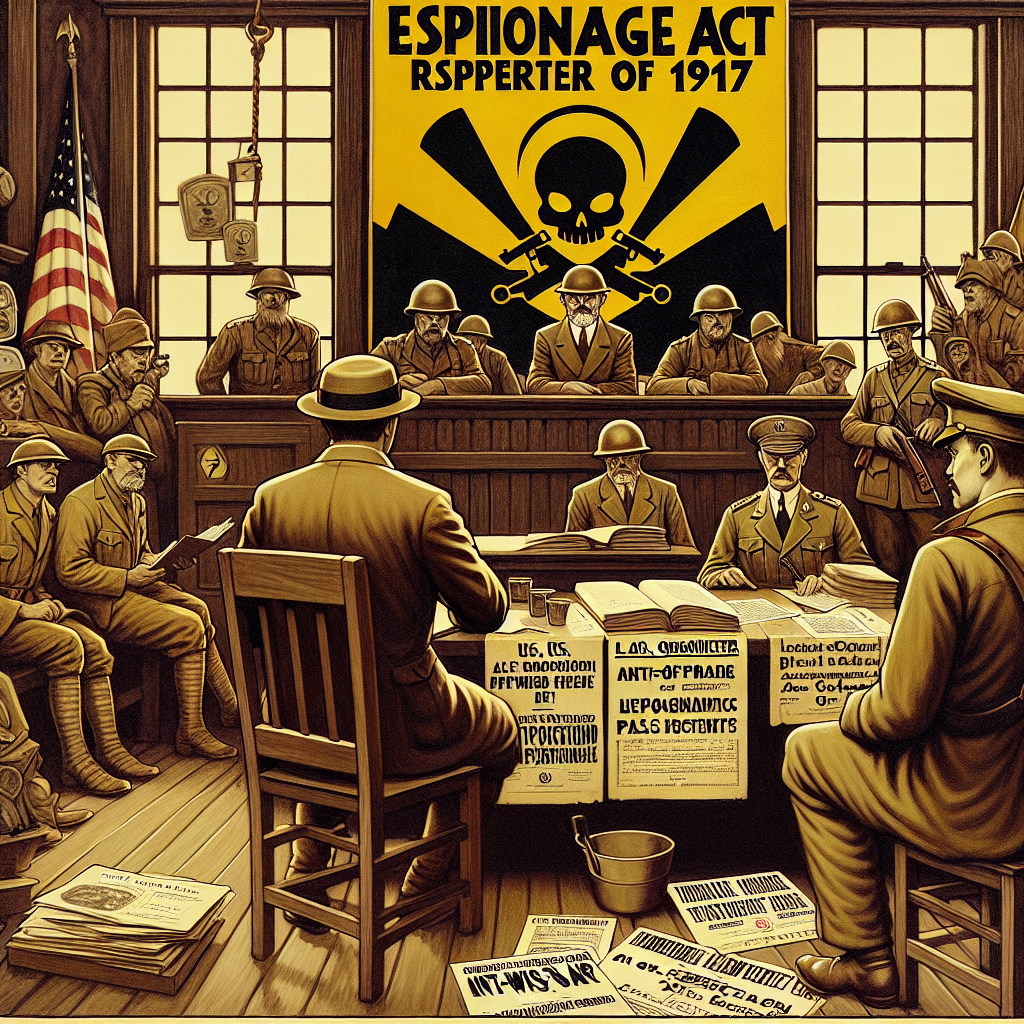
Passed by Congress on June 15, 1917, six weeks after the United States entered World War I, the Espionage Act imposed criminal penalties of up to 20 years in federal prison for anyone who interfered with military recruitment, caused insubordination in the armed forces, or transmitted information intended to aid enemies of the United States. The following year, the Sedition Act of 1918 broadened it to criminalize any "disloyal, profane, scurrilous, or abusive language" about the U.S. government, the Constitution, the military, or the flag. Together, the two laws enabled the most sweeping suppression of political speech in American history since the Alien and Sedition Acts of 1798.
The act was deployed immediately and broadly. Eugene Debs was sentenced to ten years for a Canton, Ohio speech opposing the draft. Socialist editor Victor Berger was convicted for anti-war articles in his newspaper. IWW leaders were prosecuted en masse in a single Chicago trial. The postmaster general used the act to deny mailing privileges to dozens of socialist, anti-war, and labor publications — suppressing them without trial or appeal. The Supreme Court upheld the convictions in a series of 1919 decisions, with Justice Oliver Wendell Holmes writing the opinion that introduced the "clear and present danger" test as a limit on the First Amendment.
The Espionage Act has never been repealed. It remains the primary statute under which the federal government prosecutes leakers and whistleblowers: Daniel Ellsberg was charged under it in 1971 for releasing the Pentagon Papers; Chelsea Manning was convicted under it in 2013; Edward Snowden was charged under it and fled the country. The act makes no distinction between those who transmit classified information for personal gain and those who do so to inform the public about government conduct — a gap that has generated persistent constitutional controversy about the law's compatibility with a free press.

| Enacted | June 15, 1917 |
| Penalties | Up to 20 years imprisonment |
| Expanded By | Sedition Act of 1918 (repealed 1921; Espionage Act remains) |
| Notable Prosecutions | Eugene Debs (1918); IWW leaders; Victor Berger |
| Modern Prosecutions | Daniel Ellsberg; Chelsea Manning; Edward Snowden |
| Status | Never repealed — still in force |
| Key Court Case | Schenck v. United States (1919) — Holmes's "clear and present danger" test |
| Date | Enacted June 15, 1917 |
| Location | Washington, D.C. |