The Shakers
Ann Lee was an illiterate textile worker in Manchester, England, who had lost four children in infancy and joined a small sect that worshiped by trembling, shouting, and dancing. Its members called themselves the United Society of Believers in Christ's Second Appearing. Outsiders called them the Shaking Quakers. Lee came to believe that sexual relations were the root of human sin, and her followers came to regard her as the female embodiment of Christ's spirit. In 1774 she led eight of them to New York.
They settled at Niskayuna, near Albany, and were jailed during the Revolution as suspected British sympathizers because they refused to bear arms. After Lee's death in 1784 her successors organized the faithful into self-contained communal villages. Members gave up private property, lived in gender-segregated dormitories, and practiced strict celibacy, so the society grew only by conversion and by taking in orphans. Women and men held equal authority in the leadership, which was rare anywhere in the world.
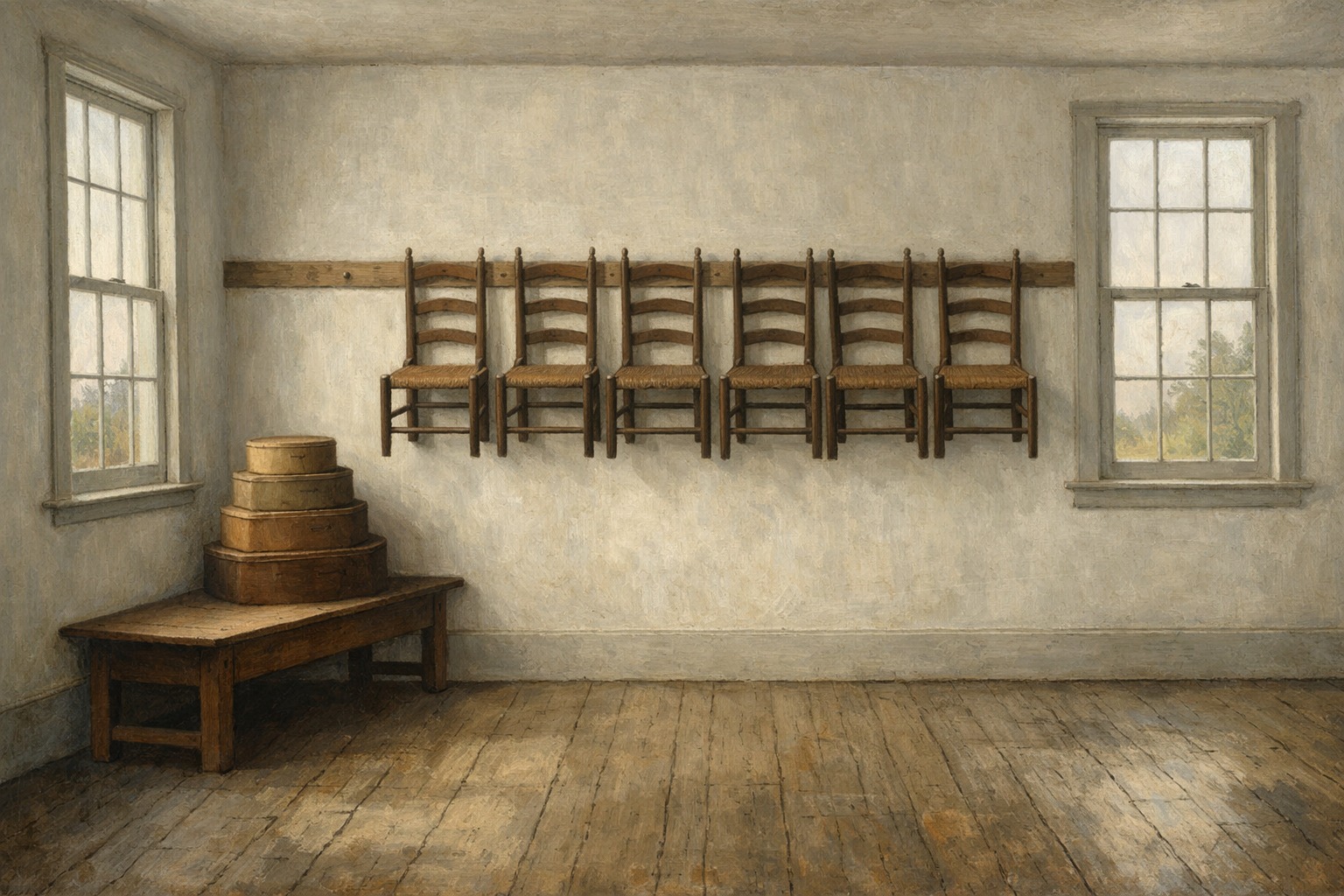
At their height in the 1840s some four to six thousand Shakers lived in about nineteen communities from Maine to Kentucky and Ohio. Their worship featured choreographed dances and thousands of songs, including Simple Gifts, written by Joseph Brackett in 1848 and later used by Aaron Copland in Appalachian Spring. They believed that work was a form of prayer, and their furniture, oval boxes, and buildings, plain and exquisitely made, became prized by collectors. They were among the first to sell seeds in paper packets.
Celibacy and the decline of rural communal life after the Civil War thinned the villages, and one by one they closed. By the early twenty-first century only one active community remained, at Sabbathday Lake in Maine, with a handful of members. Several former villages, including Hancock in Massachusetts and Pleasant Hill in Kentucky, are now museums. The Shakers are remembered less for their theology than for the beauty of what they made.
| Formal name | United Society of Believers in Christ's Second Appearing |
| Founder | Ann Lee, arrived in New York 1774 |
| First settlement | Niskayuna (Watervliet), New York |
| Peak | About 4,000 to 6,000 members in the 1840s |
| Practices | Celibacy, communal property, equality of the sexes, dance in worship |
| Last community | Sabbathday Lake, Maine |
| Date | 1774 to today |
| Location | Watervliet, New York |