LASIK
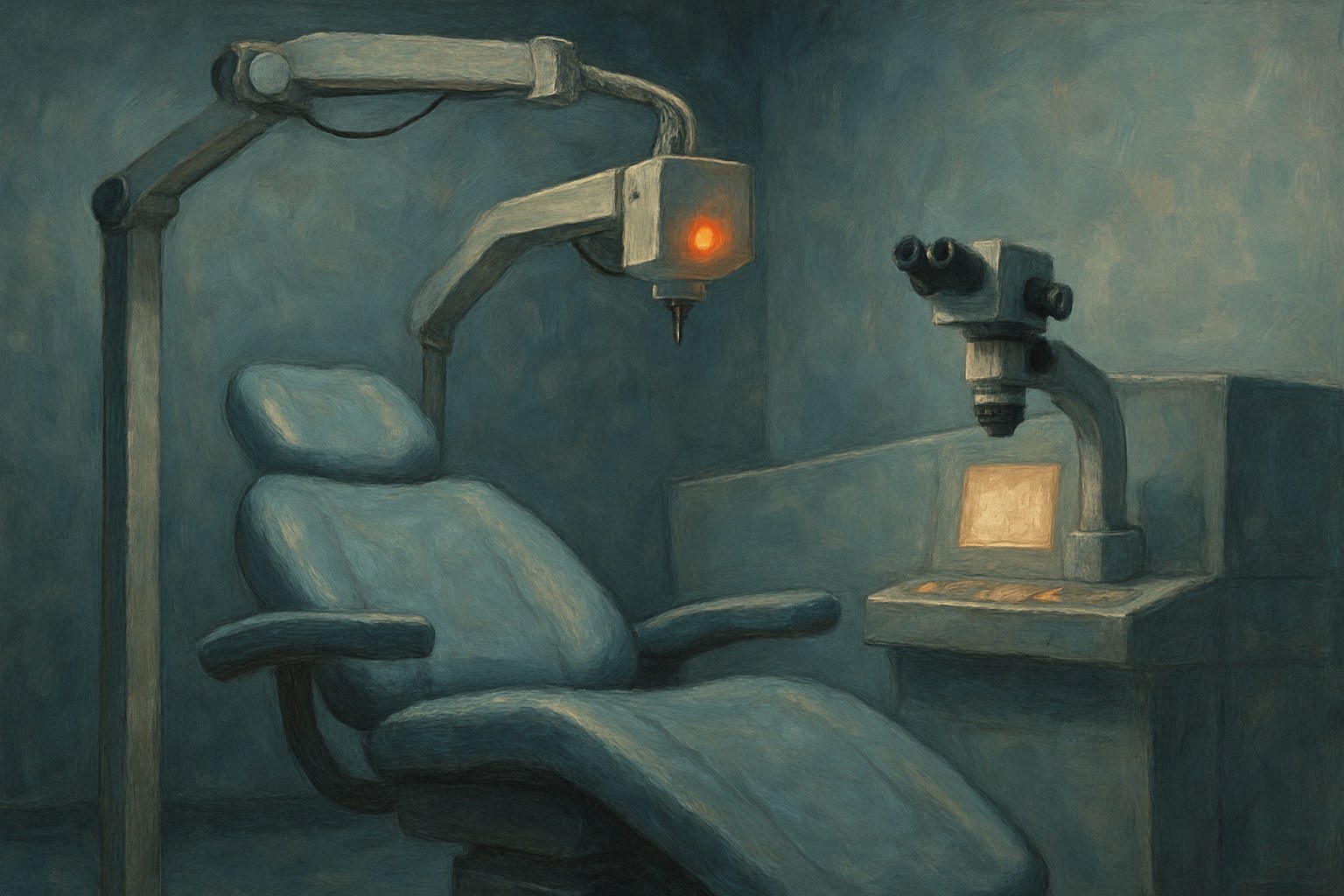
Roughly a third of Americans are nearsighted, and for the whole of the twentieth century the remedies were glasses and contact lenses. The idea of reshaping the cornea itself came out of the Soviet Union, where Svyatoslav Fyodorov refined radial keratotomy in the 1970s — a spoke pattern of deep incisions cut with a diamond blade that flattened the cornea and shifted its focus. It worked often enough to spread into American clinics in the 1980s, but the cuts weakened the eye permanently and the correction drifted over the following years.
The precision instrument arrived from an unrelated field. In 1980 Rangaswamy Srinivasan, working at IBM, found that an excimer laser could strip away organic material in exact microscopic layers without charring the tissue around it. The ophthalmologist Stephen Trokel recognized in 1983 that the same beam could sculpt a cornea to a computed prescription. The resulting operation, photorefractive keratectomy, worked, but it required scraping away the corneal surface first, which meant days of genuine pain and weeks of blurred vision while the surface regrew.
The refinement that made the procedure routine came from Ioannis Pallikaris in Crete around 1989. Instead of ablating the surface, he cut a thin hinged flap in the outer cornea, folded it back, applied the laser to the tissue underneath, and laid the flap down again, where it adhered without stitches. He called it laser-assisted in situ keratomileusis. Vision cleared within hours rather than weeks. The FDA cleared excimer lasers for surface ablation in 1995 and for the flap procedure in 1999, and the American market opened almost overnight.
What followed looked less like medicine than retail. LASIK was elective, paid in cash, and advertised on billboards and drive-time radio with per-eye pricing, discount chains, and financing plans. Millions of procedures were performed, reported satisfaction ran high, and the corrective-lens industry lost a slice of its customers permanently. It also produced a durable minority of complaints — chronic dry eye, halos and starbursts at night, and in rare cases vision worse than before — that the FDA revisited in later studies. LASIK marked the point at which a surgical procedure became a consumer product.
| Antecedent | Radial keratotomy, refined by Svyatoslav Fyodorov |
| Laser | The excimer laser — Rangaswamy Srinivasan, IBM, 1980 |
| Applied to the eye | Stephen Trokel, 1983 |
| Flap technique | Ioannis Pallikaris, Crete, about 1989 |
| FDA | Surface ablation 1995, LASIK 1999 |
| Note | Elective, cash-pay, and heavily advertised |
| Date | Developed 1989, FDA cleared 1999 |