Mount Vernon
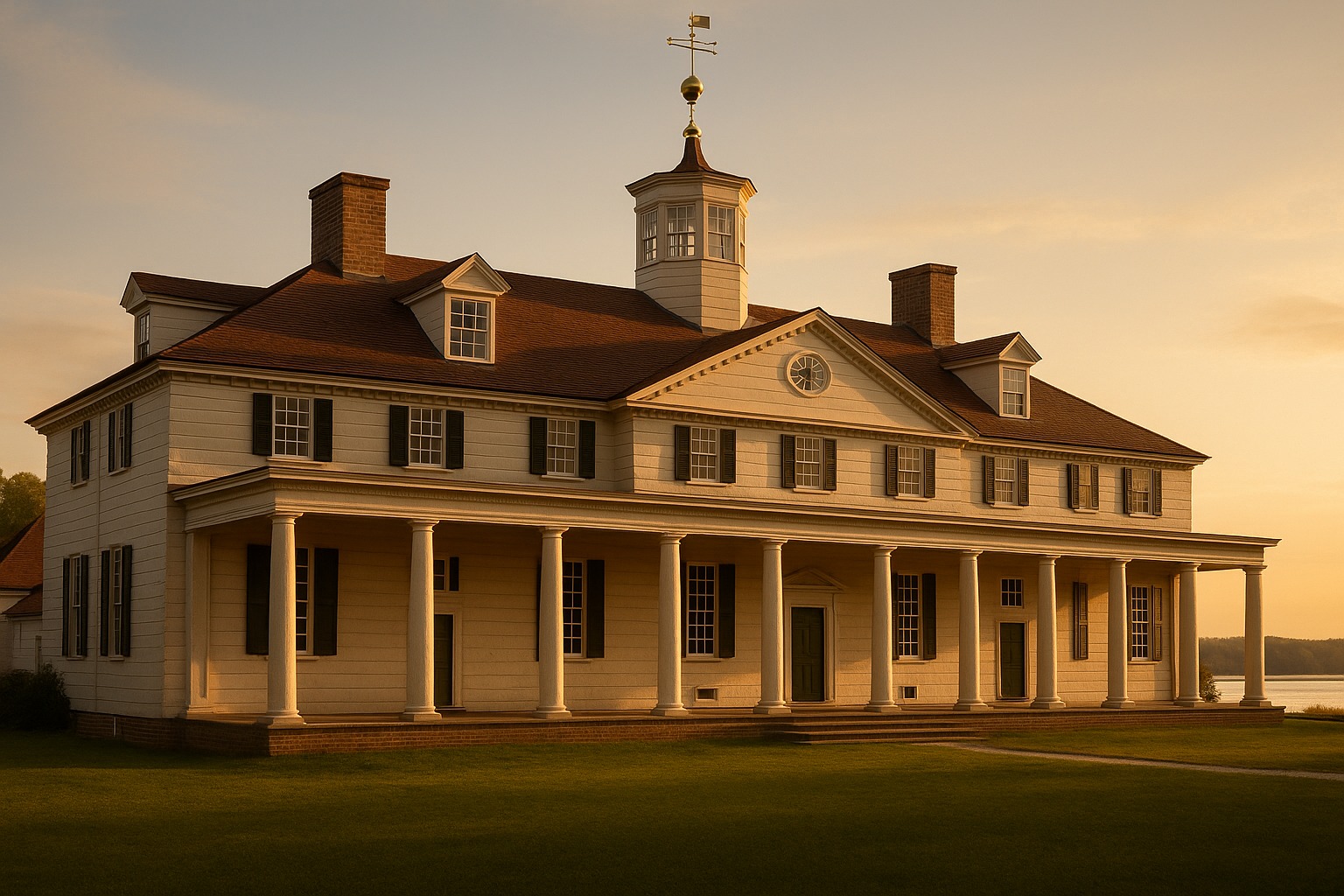
George Washington began leasing Mount Vernon from his half-brother's widow in 1754 and inherited it outright in 1761, transforming a modest eight-room farmhouse into the 21-room mansion that stands today through two major expansions — one in the late 1750s that added a second story, the other between 1774 and 1787 that added matching wings and the iconic two-story piazza overlooking the Potomac River. Washington oversaw much of this construction by letter, directing details of moldings and paint colors from army headquarters and, later, the presidency while he was away for years at a stretch. He also converted the plantation's main crop from tobacco to wheat, a shift that reduced soil exhaustion and diversified the estate's income.
At Washington's death in 1799, more than 300 enslaved people lived and worked at Mount Vernon, only about half of them his own property; the rest belonged to his wife's estate and could not legally be freed by his will. Washington's will did free the enslaved people he personally owned, conditioned on Martha Washington's death — making him the only one of Virginia's slaveholding founding presidents to free any enslaved people outright by will. Martha freed them herself in 1801, reportedly out of fear that they had an incentive to hasten her death. A reconstructed distillery on the property reflects another Washington enterprise: by 1799 he operated one of the largest whiskey distilleries in the United States.
The estate declined badly after Washington's death as his heirs struggled to maintain a property too large for a working farm's income. In 1858, the Mount Vernon Ladies' Association, founded by Ann Pamela Cunningham, purchased the mansion and 200 surrounding acres directly from the family — one of the earliest and most consequential historic preservation campaigns in American history, organized entirely by women more than 60 years before they could vote nationally. The association still owns and operates Mount Vernon today, independent of the National Park Service, and the estate draws roughly a million visitors a year to the house, grounds, and the tomb where George and Martha Washington are buried.
| Inherited by Washington | 1761 |
| Major expansions | Late 1750s and 1774-1787 |
| Enslaved people at Washington's death | More than 300 |
| Purchased for preservation | 1858, by the Mount Vernon Ladies' Association |
| Operated by | Mount Vernon Ladies' Association (private, not NPS) |
| Location | Mount Vernon, Virginia |
| Date | Inherited by Washington 1761 |
| Location | Mount Vernon, Virginia |