George S. Patton
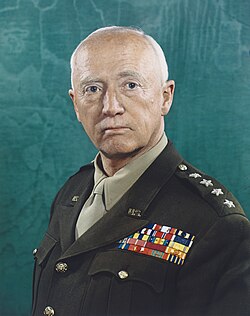
George S. Patton was the U.S. Army's most feared battlefield commander in World War II and its most turbulent personality. His Third Army's breakout from Normandy in the summer of 1944 — racing across France at a pace that stunned Allied planners and paralyzed German defenses — stands as one of the most spectacular armored advances in modern military history. German intelligence regarded him as the most dangerous Allied general in the European theater; Eisenhower exploited that reputation deliberately.
Patton had studied military history obsessively for decades and spent his career training for the mobile, armor-led warfare he believed would define the next great conflict. He commanded U.S. forces in North Africa and Sicily before his career nearly ended in August 1943, when he slapped two hospitalized soldiers he accused of cowardice. Eisenhower sidelined him for nearly a year but used him as a decoy — convinced Patton must lead the main cross-Channel assault, the German High Command kept reserves waiting for him rather than reinforcing Normandy. The deception probably saved thousands of Allied lives on D-Day.
Patton died in December 1945 from injuries sustained in a car accident near Mannheim, months after Germany's surrender. He had confided to friends that he feared peacetime irrelevance and did not know what to do with himself in a world without enemies to defeat. He did not have to find out. His doctrine — that speed and aggression saved more lives than caution, that an army stalled was an army losing — shaped armored warfare theory through the rest of the 20th century.
| Born | November 11, 1885 — San Gabriel, California |
| Died | December 21, 1945 — Heidelberg, Germany (car accident) |
| Rank | General (four-star) |
| Command | U.S. Third Army, August 1944 – May 1945 |
| Key campaigns | North Africa, Sicily, Normandy breakout, Battle of the Bulge |
| Slapping incident | August 1943, Sicily — nearly ended his command |
| Third Army advance | ~600 miles across France in 6 weeks, summer 1944 |
| Years | 1885–1945 |
| Location | European Theater, World War II |