Edison's Incandescent Light Bulb
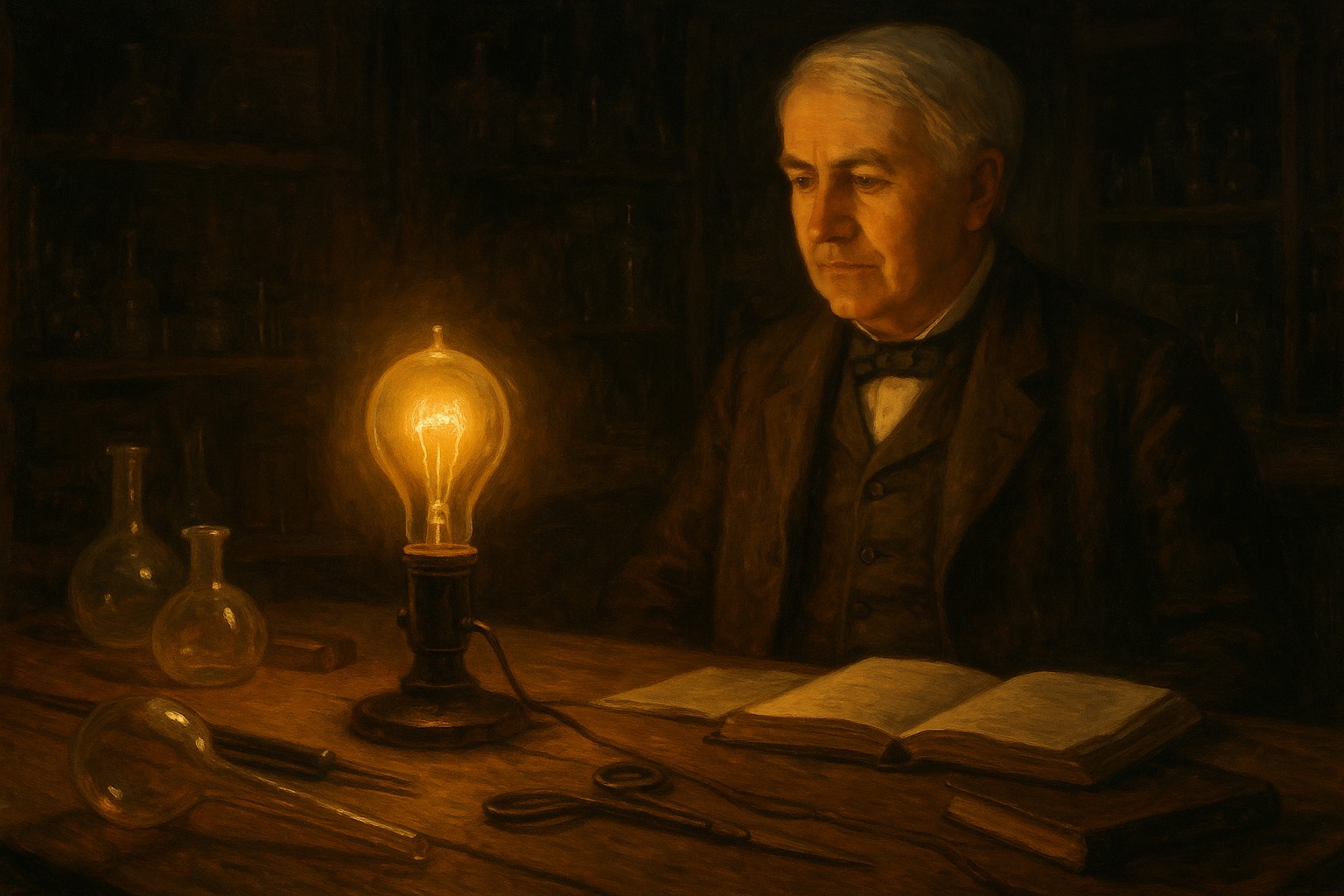
On the evening of December 31, 1879, Thomas Edison gathered reporters and investors at his laboratory in Menlo Park, New Jersey, to demonstrate an electric lamp that — unlike every previous attempt at incandescent lighting — was practical: cheap to manufacture, safe in a home, and capable of burning for hundreds of hours without melting its filament. The Menlo Park complex glowed in the winter darkness with about forty bulbs strung along the laboratory porch and the adjoining boardwalk, drawing thousands of visitors out from New York on chartered trains over the following weeks. The age of gaslight and oil lamps had not ended yet, but the path out of it was now visible.
Edison was not the first inventor of an incandescent bulb. Joseph Swan in England, Henry Woodward and Mathew Evans in Canada, and at least a dozen others had built working filaments before 1879. What Edison did was engineer the entire system. His Pearl Street generating station, opened in lower Manhattan on September 4, 1882, fed electricity through underground copper conduits to 85 buildings — the first commercial electric power plant in the United States — and the bulbs at the other end were screwed into sockets, regulated to standard voltages, and metered by devices Edison's shops also built. He sold light, not a curiosity.
The patent fights ran for two decades, eventually consolidated through the merger that produced General Electric in 1892. Edison's direct-current distribution system lost the "War of the Currents" to George Westinghouse and Nikola Tesla's alternating current in the 1890s, ending Edison's dominance of the industry he had effectively created. The bulb itself evolved through a century of refinement — carbonized bamboo, then tungsten, then halogen, then LED — and the original incandescent design Edison demonstrated in 1879 was phased out by U.S. efficiency standards in the 2010s. The Menlo Park laboratory is preserved at Greenfield Village in Dearborn, Michigan, reassembled brick by brick by Henry Ford.

| Demonstration | December 31, 1879 — Menlo Park, New Jersey |
| First commercial station | Pearl Street, NYC — September 4, 1882 |
| Patent | U.S. Patent 223,898 (January 27, 1880) |
| Initial filament | Carbonized bamboo |
| Early competitors | Joseph Swan (UK), Woodward & Evans (Canada) |
| Result | War of the Currents (DC vs AC) won by Westinghouse/Tesla |
| Corporate descendant | General Electric (1892 merger) |
| Date | Demonstration: December 31, 1879 · Pearl Street station: September 4, 1882 |
| Location | Menlo Park, New Jersey |