Wild Bill Hickok
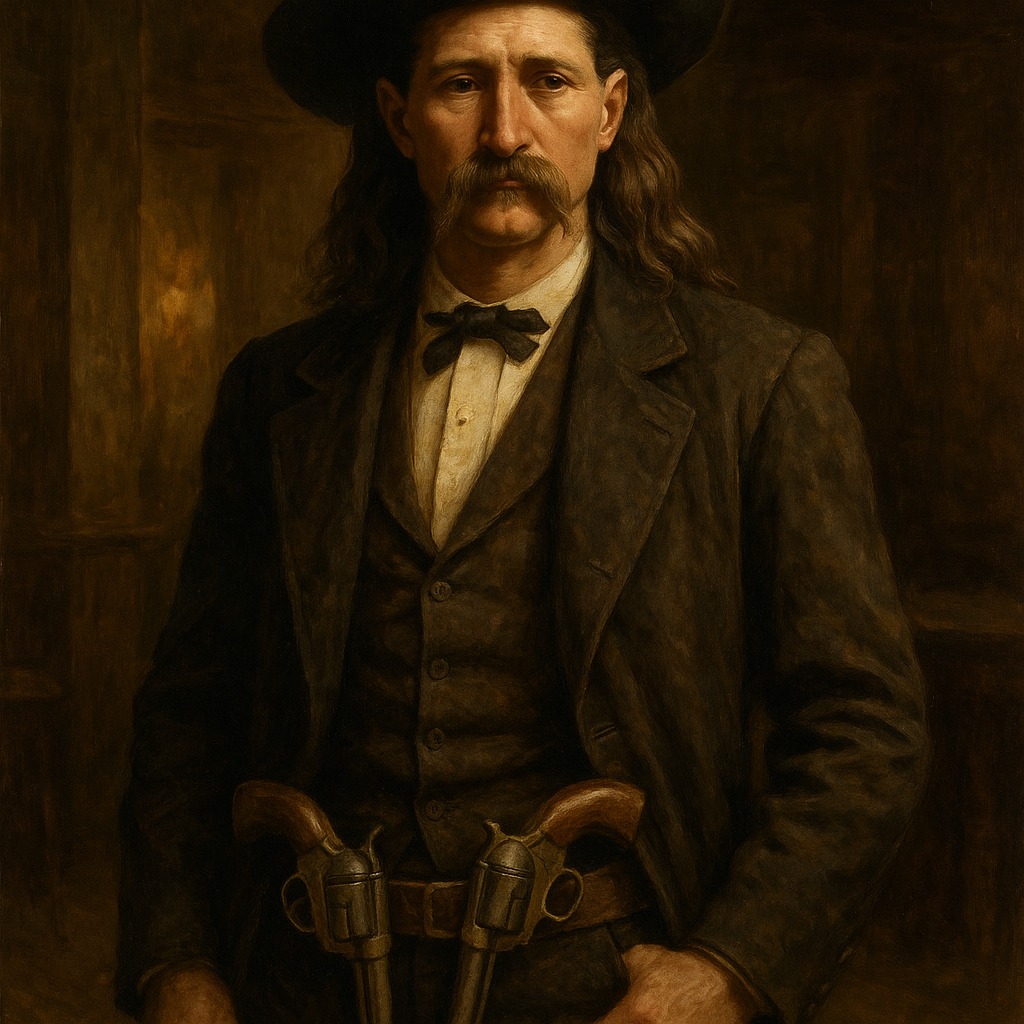
James Butler Hickok earned the name Wild Bill as a Union scout and spy during the Civil War, slipping through Confederate lines in Missouri and Arkansas to carry intelligence back to federal commanders. Afterward he drifted onto the plains as a stagecoach driver, army scout, and occasional gambler, and in 1865 he killed a man named Davis Tutt in a street duel at Springfield, Missouri over an unpaid debt and a pocket watch — one of the first quick-draw gunfights to be reported nationally, and the one that made his name.
Hickok turned the reputation into a badge. As marshal of Hays City and then Abilene, Kansas, in 1869 and 1871, he kept order in cattle-drive boomtowns by sheer nerve and a willingness to use his pistols first, killing at least two men in Abilene before the town fired him for being too costly to insure. Between law jobs he toured briefly with Buffalo Bill Cody's stage show, playing a frontier scout for Eastern audiences who already knew him only as a dime-novel character, his real record of gunfights blurred into theater.
On August 2, 1876, Hickok was playing poker in Deadwood, Dakota Territory, and broke his own rule of always sitting with his back to the wall because the only open seat faced away from the door. Jack McCall, a drifter with a grudge, shot him in the back of the head; Hickok died holding two pairs, aces and eights, a hand gamblers still call the dead man's hand. He was 39. McCall was hanged for the murder the following year after a second trial overturned a rigged acquittal from the first.
| Born | May 27, 1837 — Troy Grove, Illinois |
| Died | August 2, 1876 — Deadwood, Dakota Territory (age 39) |
| Role | Union scout, frontier lawman, gambler |
| Marshal of | Hays City and Abilene, Kansas |
| Killed by | Jack McCall (hanged for the murder in 1877) |
| Famous hand | Aces and eights — the "dead man's hand" |
| Date | May 27, 1837 – August 2, 1876 |
| Location | Deadwood, Dakota Territory |