The Moving Assembly Line
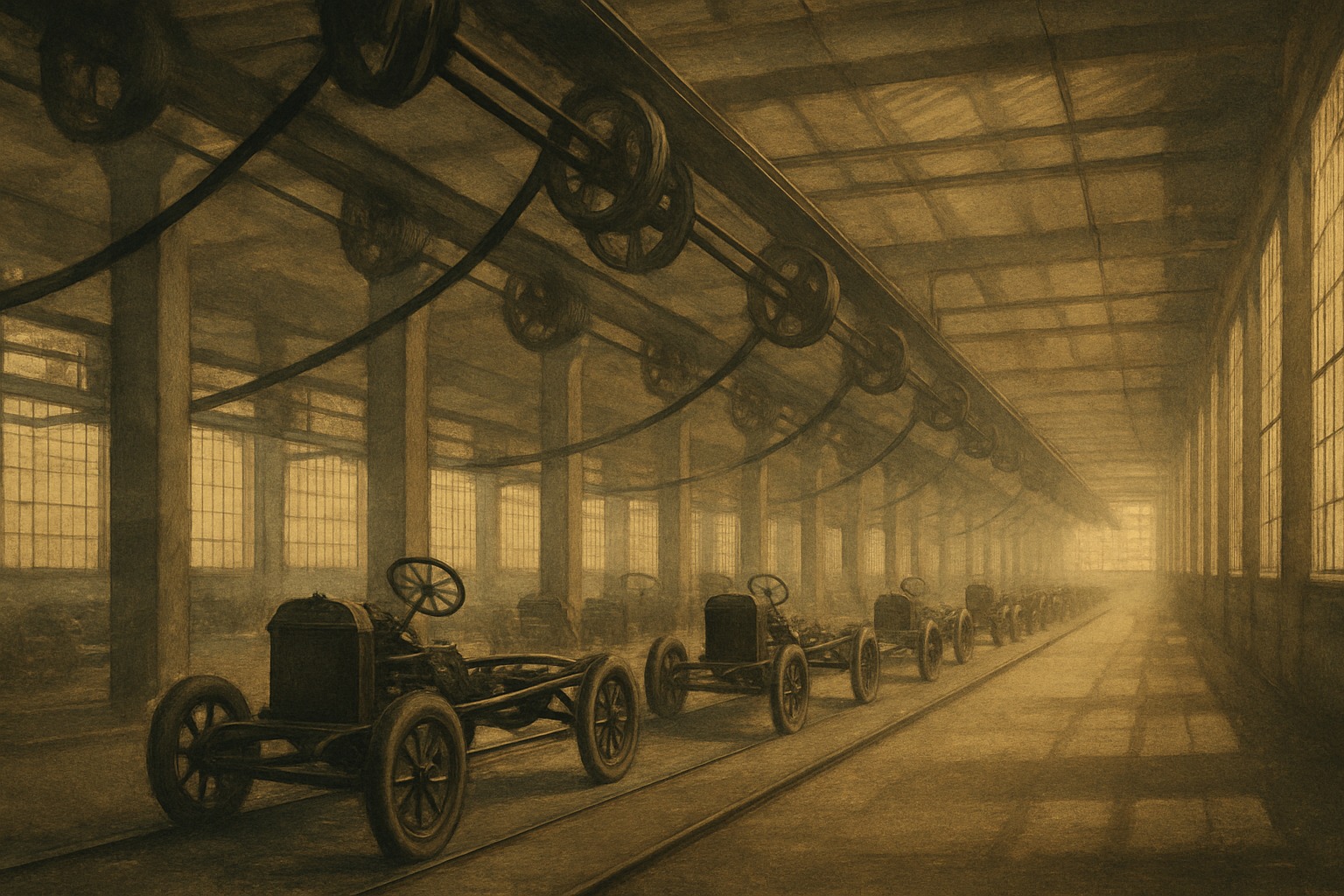
In 1913, at Henry Ford's Highland Park plant near Detroit, the moving assembly line transformed manufacturing. Instead of workers moving to the product, the product moved past stationary workers, each performing one small task — and the time to build a Model T fell from over twelve hours to about ninety minutes.
The efficiency gains were staggering. Ford slashed the price of the Model T even as he raised output to millions, putting cars within reach of ordinary families. To keep workers at the monotonous pace, Ford famously doubled wages to five dollars a day in 1914 — a wage high enough that his own workers could afford the cars they built.
The technique spread far beyond automobiles. Mass production on the assembly line became the template for twentieth-century industry, producing everything from appliances to aircraft at unprecedented scale and low cost, and helping make the United States the world's manufacturing powerhouse.
It also remade work itself. The assembly line made labor faster and cheaper but also more repetitive and impersonal, fueling both the consumer abundance and the labor tensions of the industrial age. Few innovations did more to shape how modern things are made — and how modern work feels.
| Introduced | 1913, Ford's Highland Park plant |
| Effect | Model T build time fell from ~12 hours to ~90 minutes |
| $5 Day | Ford doubled wages in 1914 to hold workers |
| Spread | Became the template for all mass production |
| Date | Introduced 1913 |